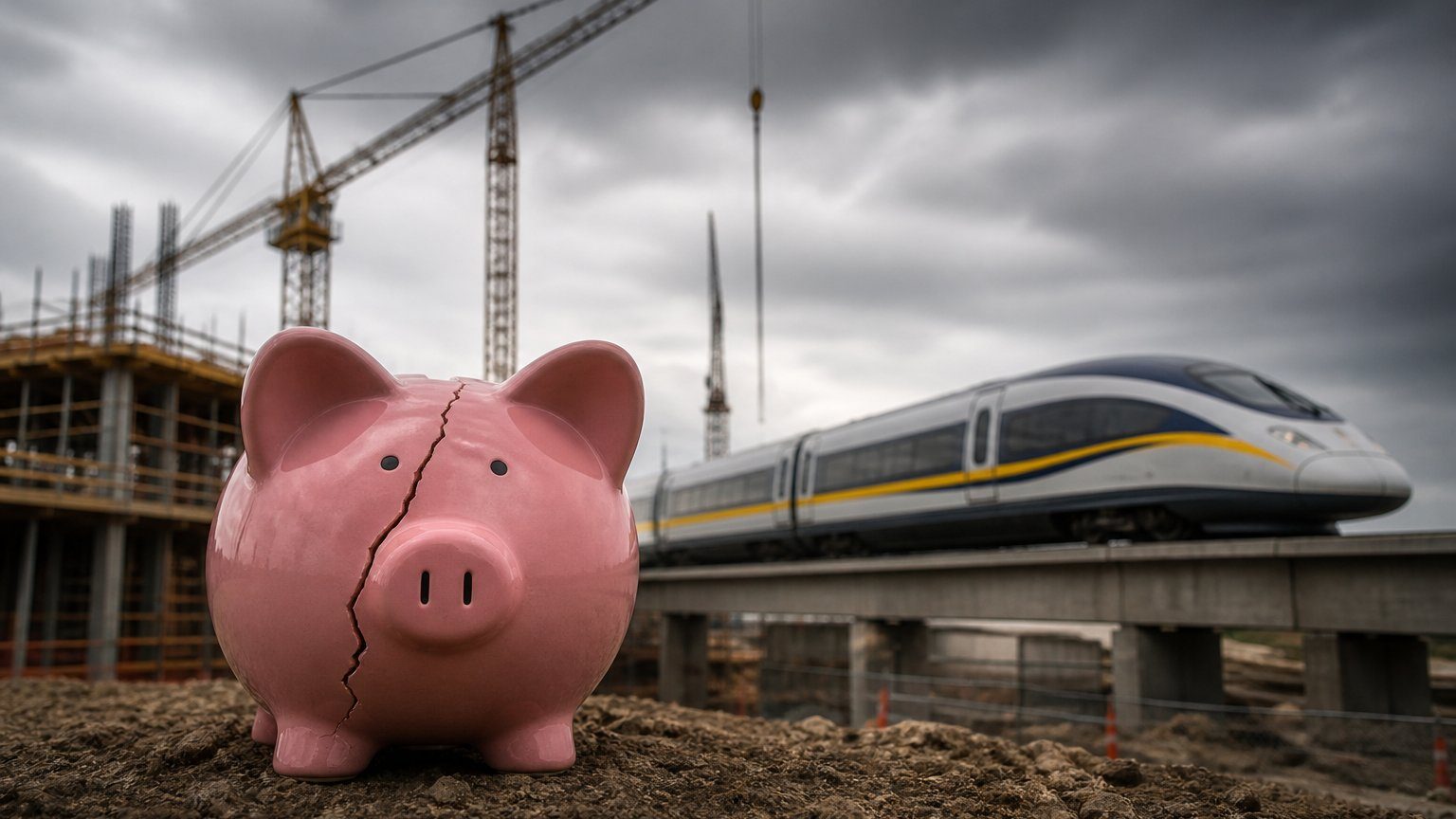
California’s bullet train is back under a hard spotlight as state watchdogs warn the California High-Speed Rail Authority could run out of money by December 2027. The latest warning lands as the long-promised California bullet train faces fresh questions about whether the project can stay on track without a major financing rescue.
The Office of the Inspector General said the agency would need to borrow as much as $9.5 billion over five years just to maintain the current construction schedule. In a report delivered last month to Gov. Gavin Newsom and lawmakers, Inspector General Benjamin Belnap said rail officials had “obscured basic facts about the project, hindering lawmakers’ ability to provide effective oversight of the project.” State Sen. Tony Strickland, a Republican from Huntington Beach, said the warning was no surprise and repeated his view that the project is a costly failure. He said that during a spring informational hearing, both the nonpartisan Legislative Analyst’s Office and the inspector general could not identify a reliable funding source. He also pointed to the LAO’s description of the public-private partnership plan as “risky,” arguing that such deals only work when real funding is already in place.
The inspector general’s findings go beyond the immediate cash warning. The report says some of the project’s recent savings come not from better efficiency, but from plans to build less. The authority’s preferred route would shorten the Merced-to-Bakersfield segment from 171 miles to 162 miles, move the planned Merced station out of downtown, and temporarily stop trains north of downtown Bakersfield. In the report’s words, the savings are not the result of delivering the same scope for less money, but of reducing the scope itself.
Financing the Merced-to-Bakersfield segment could also pile on another major burden. The inspector general found that borrowing could add between $3.6 billion and $6.6 billion in interest costs, an amount not included in the authority’s current $35.7 billion estimate for that portion of the line. That matters because the project has long been sold as a transformative infrastructure link, yet the numbers continue to move in the wrong direction. The original concept of a high-speed line between San Francisco and Los Angeles has seen cost projections swing from $126 billion to $231 billion, according to KCRA 3, which first reported the inspector general’s findings.