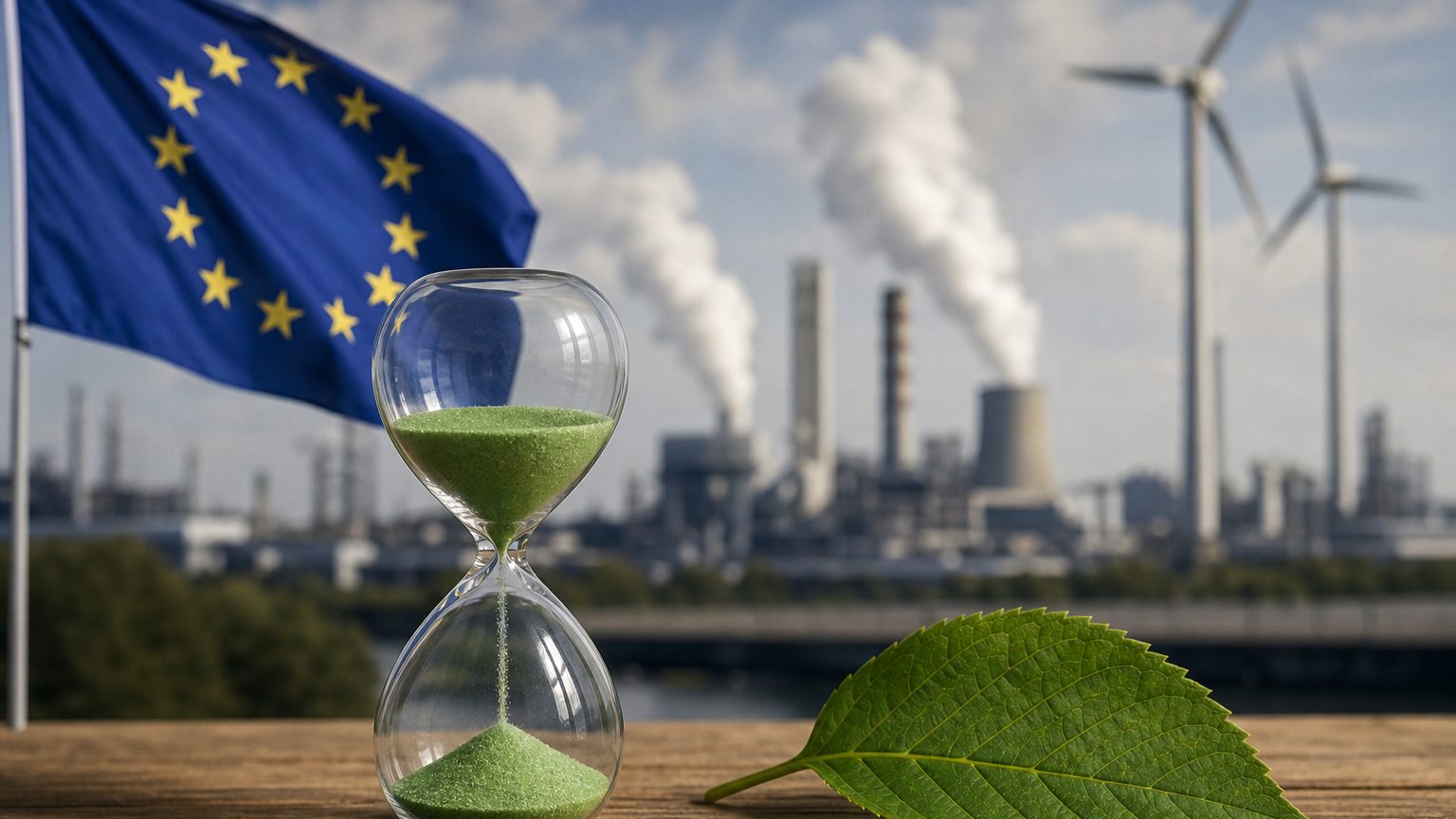
EU carbon cuts are set to slow under new proposals that would give some businesses more time to reduce emissions through the bloc’s trading system.
The European Union has put forward new proposals on EU carbon cuts that would give businesses more time to bring down their greenhouse gas emissions. The plan is part of a wider overhaul of the bloc’s climate policy and would ease some of the rules in the emissions trading system, or ETS.
Under the draft changes, some industries could keep receiving emission allowances until 2038 instead of 2034, if they agree to invest in decarbonisation. The European Commission said the aim is to keep the ETS in line with the EU’s target of cutting carbon emissions by 90% by 2040, compared with 1990 levels. The proposals still need approval from EU countries and lawmakers, a process that could take a year.
Wopke Hoekstra, the EU climate commissioner, defended the shift as a more practical approach for industry. The ETS, introduced in 2005, is the bloc’s main system for reducing greenhouse gases. It requires power plants and industrial companies to buy permits for every tonne of carbon dioxide they release, creating pressure to invest in cleaner technology. Businesses can also trade permits, and some receive free allowances to help them compete with firms outside the EU that do not face the same carbon costs.
The Commission also wants to slow the pace at which the cap on permits is reduced each year. It has proposed a drop to around 3.7% from 2031, then to 1.7% from 2036, compared with 4.3% now. Another part of the plan would extend free permits until 2038, rather than ending them in 2034, when they were due to be replaced for some sectors by a carbon border charge on imports. The Commission would give companies 80% of those free permits up front if they have plans to invest in decarbonisation in Europe, with the final 20% released once the investment is made.
The proposal has already drawn opposition from some quarters. Poland’s climate minister, Paulina Hennig-Kloska, said her country would push to weaken the policy further. Green politicians were sharply critical, with German European Parliament member Michael Bloss warning that the plan would increase climate pollution and leave younger generations worse off.
The debate comes as Europe continues to warm quickly and faces more frequent and intense heat. This year, more than a dozen countries across western, central and eastern Europe broke their June temperature records, and places including Hungary, the Czech Republic and Germany saw temperatures above 40C. The EU carbon cuts fight matters because it could shape how fast European industry pays to clean up its emissions, and that has real effects on energy, prices and climate policy beyond Europe.