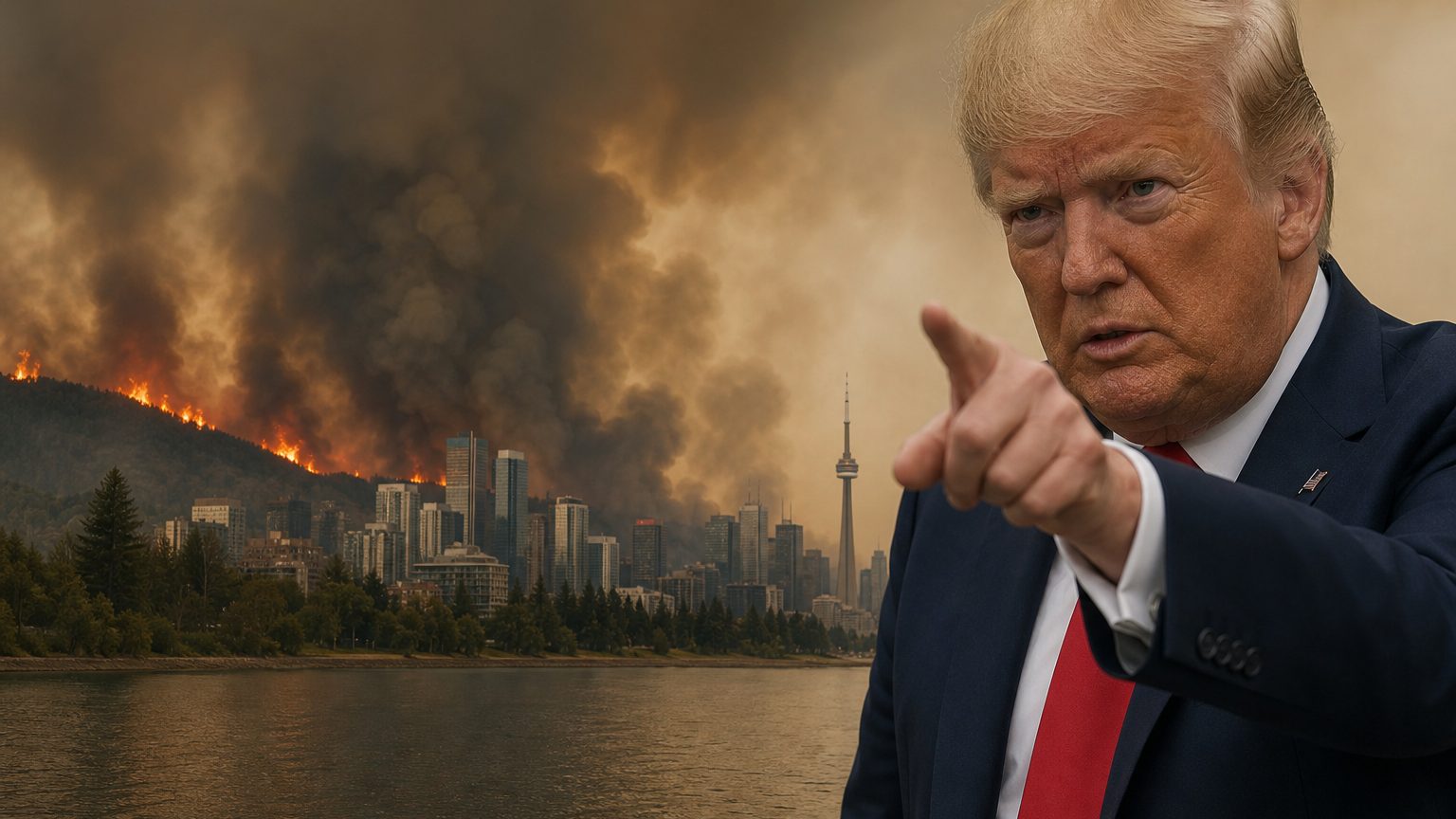
Canada wildfire smoke has spread across northern U.S. cities, prompting President Trump to threaten new tariffs as hazardous air disrupts daily life.
Canada wildfire smoke spreading across the northern United States has prompted President Donald Trump to threaten new tariffs on Canada, accusing the country of failing to manage its forests and brush. Trump said on Truth Social that he planned to call Canadian Prime Minister Mark Carney for an explanation. His warning came as smoke triggered hazardous air alerts, disrupted summer activities and reduced visibility from the Midwest to the East Coast.
Canada had about 888 active wildfires as of Friday, according to the Canadian Wildland Fire Information System, with most listed as out of control. More than 190 fires were burning in Ontario, while British Columbia reported more than 59 active blazes. Nearly three million hectares have burned across Canada. Some northern Ontario residents, including members of First Nations communities, have been evacuated as fires threatened remote areas.
The smoke reached Minnesota, Michigan, Pennsylvania, Ohio, New York and other states. IQAir, a Swiss air-quality tracker, ranked Detroit’s air as the world’s worst on Friday, followed by Chicago. Washington, D.C., and New York also ranked among the most polluted cities. Officials urged residents in affected areas to remain indoors, while some communities distributed masks. Camps moved activities inside, concerts were rescheduled, a beach closed, and low visibility caused some flight delays.
Republican Representatives John James, John Moolenaar, Jack Bergman and Lisa McClain sent Canadian officials a letter arguing that Canada had not moved fast enough to address forest thinning, fuel reduction, prescribed burns and alleged arson. They warned that the United States could consider a more direct role in cross-border fire prevention and response. Some Republicans also revived Trump's proposal to make Canada the 51st state, an idea that has angered Canadians and contributed to some travelers avoiding the United States.
Canadian officials rejected the suggestion that Ottawa had neglected the threat. Emergency Management Minister Eleanor Olszewski said the two countries remain in regular contact and pointed to a reciprocal firefighting agreement dating to 1982, as well as an assistance agreement tied to the 2025 G7 summit. She said Canada has invested about C$12 billion, or $8.5 billion, in forest sustainability and wildfire prevention. Ontario Premier Doug Ford said more than 150 crews and over 80 water bombers and helicopters were fighting the fires. He also noted that Canada previously helped the United States respond to California wildfires and North Carolina hurricanes, while Michigan and Massachusetts had offered assistance.
Carney said both nations share responsibility for addressing climate change and said his government was coordinating with provinces and communities. Scientists cited sustained heat, below-average rainfall and lightning as factors behind the outbreak. They also said many fires are burning in vast, remote forests where early detection and containment are difficult. Better forest management can lower danger near populated areas, experts said, but cannot eliminate fire across such a large ecosystem. The Canada wildfire smoke also raised concerns about the Argentina-Spain World Cup final at New Jersey's open-air MetLife Stadium, though forecasters expected weekend rain to improve conditions. The takeaway: Americans are facing immediate health and travel disruptions while the tariff threat risks adding another dispute to an already strained U.S.-Canada trade relationship.