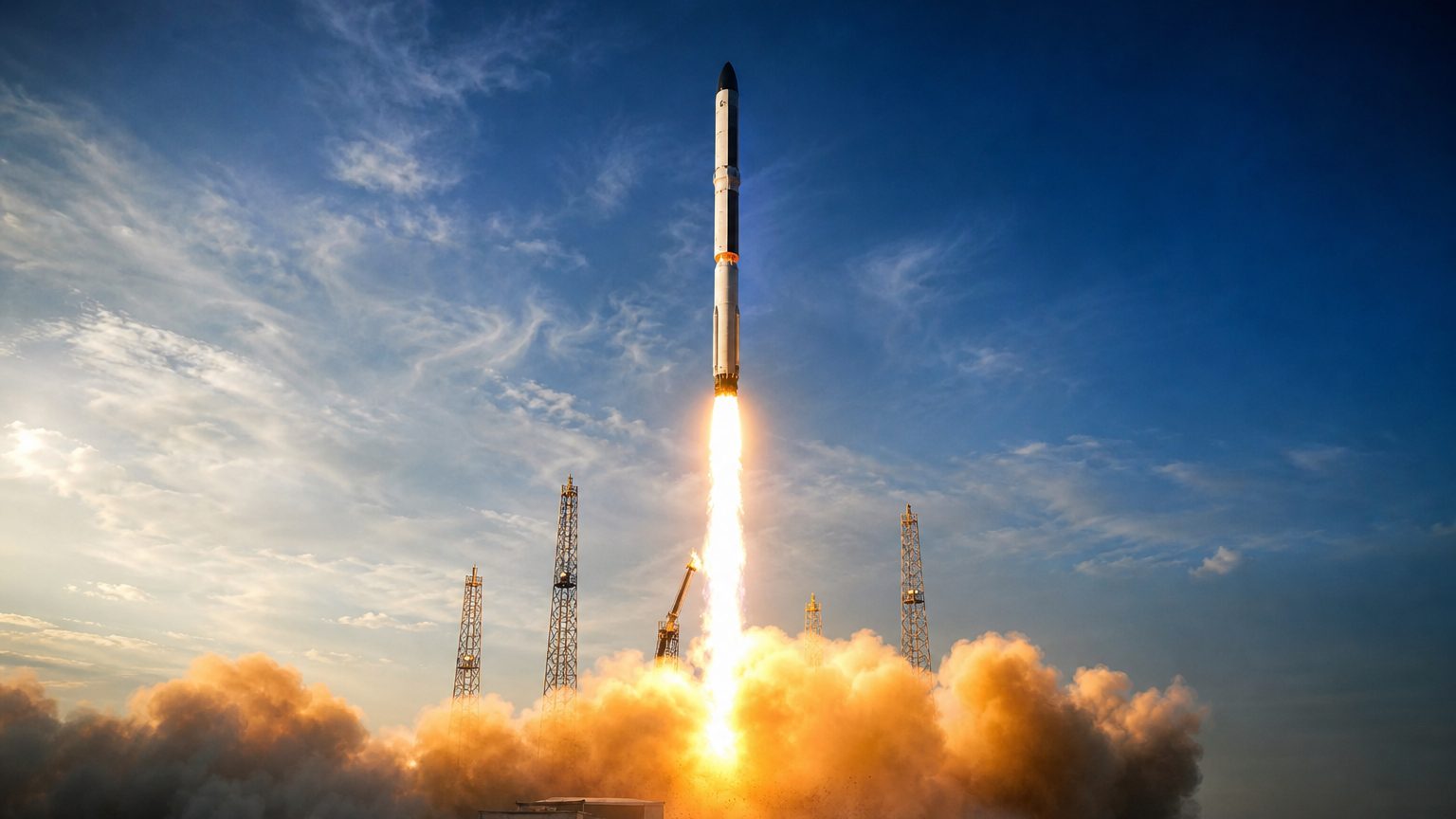
The Vikram-1 launch made Skyroot Aerospace the first private Indian company to reach orbit, placing India alongside the U.S. and China.
The Vikram-1 launch put Skyroot Aerospace into the record books Saturday as the first private Indian company to send a rocket into orbit. The seven-story vehicle lifted off from the Indian Space Research Organisation’s facility in Sriharikota, southern India, at 12:05 p.m. local time. Skyroot said the rocket reached low Earth orbit after a 16-minute flight covering 280 miles. The achievement makes India the third nation, after the United States and China, to have a private company with orbital launch capability.
Skyroot recently became India’s first space-technology unicorn after reaching a valuation of $1.1 billion. The Vikram-1 rocket, named for Indian space pioneer Vikram Sarabhai, can carry payloads weighing up to 350 kilograms. Co-founder and CEO Pawan Kumar Chandana said the company wants to provide dedicated launches for smaller satellites, which often must wait months or years for space aboard larger rockets operating on fixed schedules.
The company compares its planned service to hiring a cab rather than waiting for a train. Customers would be able to reserve a mission based on a satellite’s size and required orbit. The business model resembles that of U.S.-based Rocket Lab, which also provides small-lift launch vehicles. Skyroot expects its approach to serve satellite operators that need more control over launch timing and orbital destination.
Saturday’s test mission, called Aagman, the Sanskrit word for arrival, carried six payloads into orbit. They included satellites, an Earth observation camera and a robotic arm intended to remove space debris. One satellite came from a German company. The mission also carried two symbolic items: a lotus made from laboratory-grown diamonds and a small gold rocket featuring microscopic sculptures honoring Sarabhai, Nobel Prize-winning physicist CV Raman and aerospace engineer and former Indian President APJ Abdul Kalam.
The Vikram-1 launch was the first of two test flights Skyroot plans before beginning commercial missions next year. Chandana said the company’s factory in Hyderabad can build one rocket each month. He founded Skyroot in 2018 with Naga Bharath Daka after both men left their positions at Isro. The company first drew broad attention in November 2022, when it launched India’s first privately developed suborbital rocket.
India opened its space industry to private firms in 2020, allowing companies to develop rockets and satellites while using Isro launch sites. The government aims to increase India’s share of the global space business from 2% to 10% by 2030 and says more than 400 domestic space start-ups have formed since the policy change. Skyroot says 70% to 80% of its market could come from the global economy, including satellites supporting agriculture, fisheries, communications, navigation, disaster management and national security. For Americans, the takeaway is clear: India’s growing private launch sector is becoming a new force in a global space market that includes U.S. companies and supports services tied to commerce, connectivity and security.