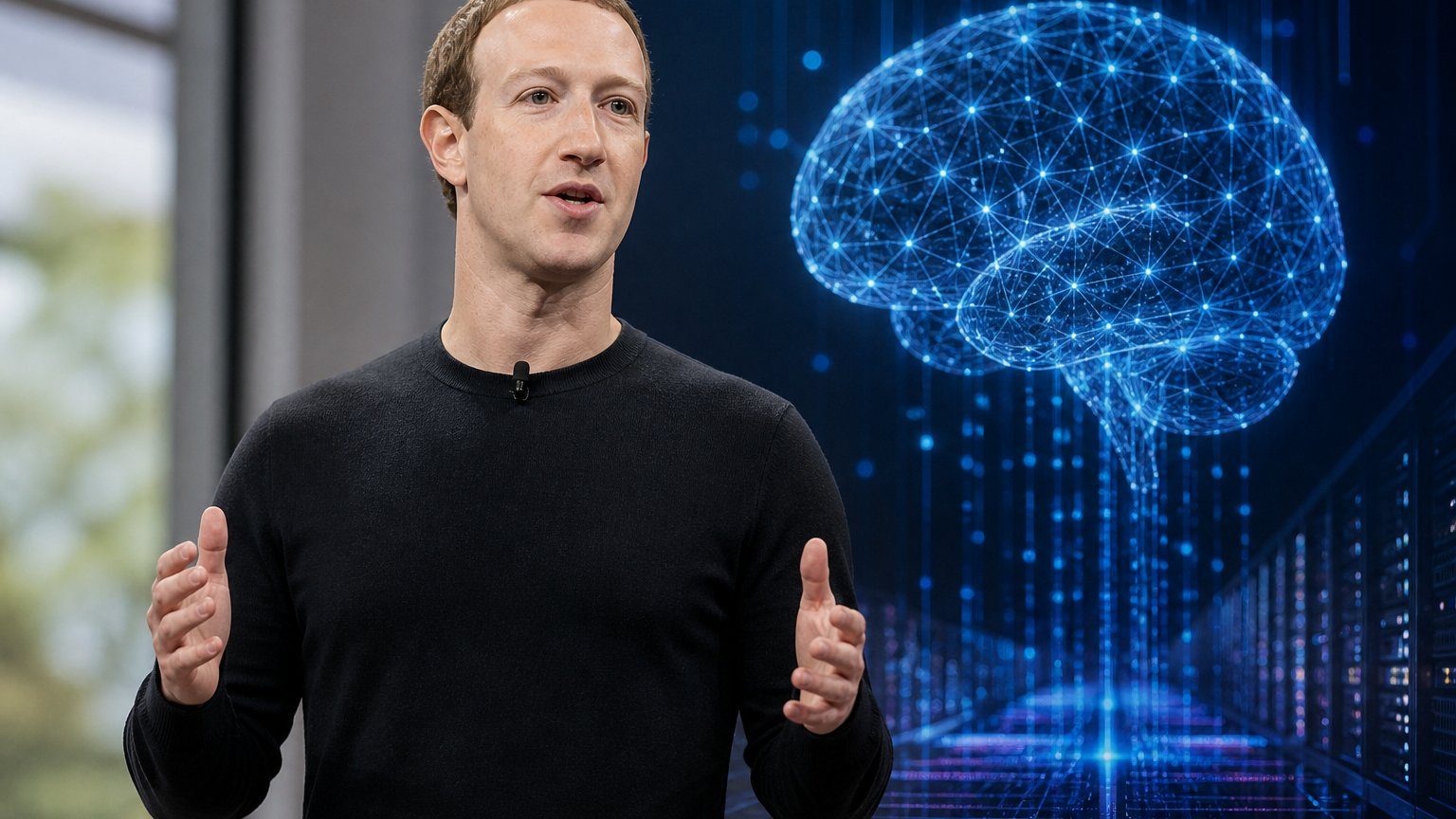
Meta’s new AI model lands as Mark Zuckerberg urges Washington to ease barriers for U.S. open-source developers and counter Chinese rivals.
Meta’s new AI model arrived Monday with a clear political message: the United States should do more to help homegrown open-source developers keep pace with China. CEO Mark Zuckerberg used the launch to press Washington to lower barriers he says are holding American companies back in the race for AI leadership.
Zuckerberg argued that U.S. policy should be designed to make American open-source models the strongest in the world. In a manifesto titled “The Future is for Everyone: The Path to a Positive AI Future,” he wrote that the United States and its allies need to lead the open source AI ecosystem because it could account for a large share of global AI use. He also said foreign labs have an edge because American labs must follow additional restrictions on training data.
The remarks reflect a widening policy and business debate around artificial intelligence, one in which questions about openness, competition and national security are increasingly intertwined. Open-source and open-weight models have become especially important because they can be widely adopted, modified and embedded into commercial products more easily than tightly controlled systems. For companies building applications on top of AI, those qualities can translate into faster development and lower costs.
Meta’s move comes as Chinese open-weight models are gaining traction with U.S. businesses. Companies in the United States have been drawn to them because they can deliver increasingly competitive performance at a lower cost than some American alternatives. That shift has added urgency to the debate in Washington, where policymakers are weighing new restrictions over national-security concerns while American firms continue to face pressure to innovate quickly.
Among the Chinese firms drawing attention are DeepSeek, Alibaba and Z.ai. Their models have emerged as low-cost alternatives, and some U.S. tech companies have begun embracing them for their flexibility and cheaper computing costs. In an industry where access to computing power remains a major expense, the appeal of models that can perform well without the same price tag has helped boost their profile.
“Meta’s new AI model lands as Mark Zuckerberg urges Washington to ease barriers for U.S. open-source developers and counter Chinese rivals.”
The growing presence of Chinese systems in the U.S. market has complicated the competitive picture for American developers. On one hand, these models expand choice and can accelerate adoption of AI tools across business sectors. On the other, their rise raises concerns among lawmakers and officials who worry that dependence on foreign-built technology could pose security and strategic risks, especially if the models are used in sensitive settings.
Those concerns have already produced concrete limits. DeepSeek is barred from U.S. intelligence-community systems, and lawmakers have floated broader restrictions on Chinese AI models. Officials are also considering additional curbs on Chinese open-weight technology, underscoring how closely the AI race is being linked to broader questions about supply chains, data control and geopolitical competition.
Meta’s positioning also highlights a tension at the center of the U.S. AI debate: whether regulation and safeguards are best handled as necessary guardrails or as obstacles that slow domestic companies relative to overseas rivals. Zuckerberg’s argument is that American developers should not be placed at a disadvantage by rules that foreign competitors can avoid, especially in a field that is moving quickly and shaping everything from consumer software to enterprise systems.
For Meta, the release is not just a product announcement but part of a broader push to define the future of AI development. As open-source models become more influential in business and public life, the contest over who leads that ecosystem is becoming a contest over standards, access and long-term technological power. Zuckerberg’s message was that the United States should aim to lead that race, not merely participate in it.
Frequently asked questions
What did Meta launch?
Meta released a new Artificial Intelligence model on Monday as part of its push to compete in open-source AI.
What message did Mark Zuckerberg send to Washington?
He urged the United States to lower barriers for American open-source developers so they can better compete with Chinese rivals.
Why are Chinese AI models getting attention in the United States?
They are seen as increasingly competitive and cheaper than some American rivals, with lower computing costs and more flexibility.
How is Washington responding to Chinese AI models?
DeepSeek is already barred from U.S. intelligence-community systems, and lawmakers and officials are weighing broader restrictions.
We value your privacy 🍪We use cookies for essential features and, if you allow it, to send you a notification whenever we publish a new story. See our Privacy Policy.
📨
Never Miss a Story
Get the headlines that matter delivered straight to your inbox.
📱 On iPhone: tap the Share icon, choose “Add to Home Screen”, then open TheTrueDefender from your Home Screen and tap 🔔 to turn on notifications. (Apple only allows notifications for saved web apps.)
🔔
Never miss a breaking storyGet free alerts the moment big US news breaks.
1Tap the ••• menu at the bottom of the screen, then tap Share(in Safari, just tap Share in the bottom bar directly)2Scroll down the menu and tap Add to Home Screen3Tap Add in the top-right corner4Open TheTrueDefender from your Home Screen, then tap 🔔 Subscribe and choose Allow
📱 Add TheTrueDefender to your home screen for one-tap access.