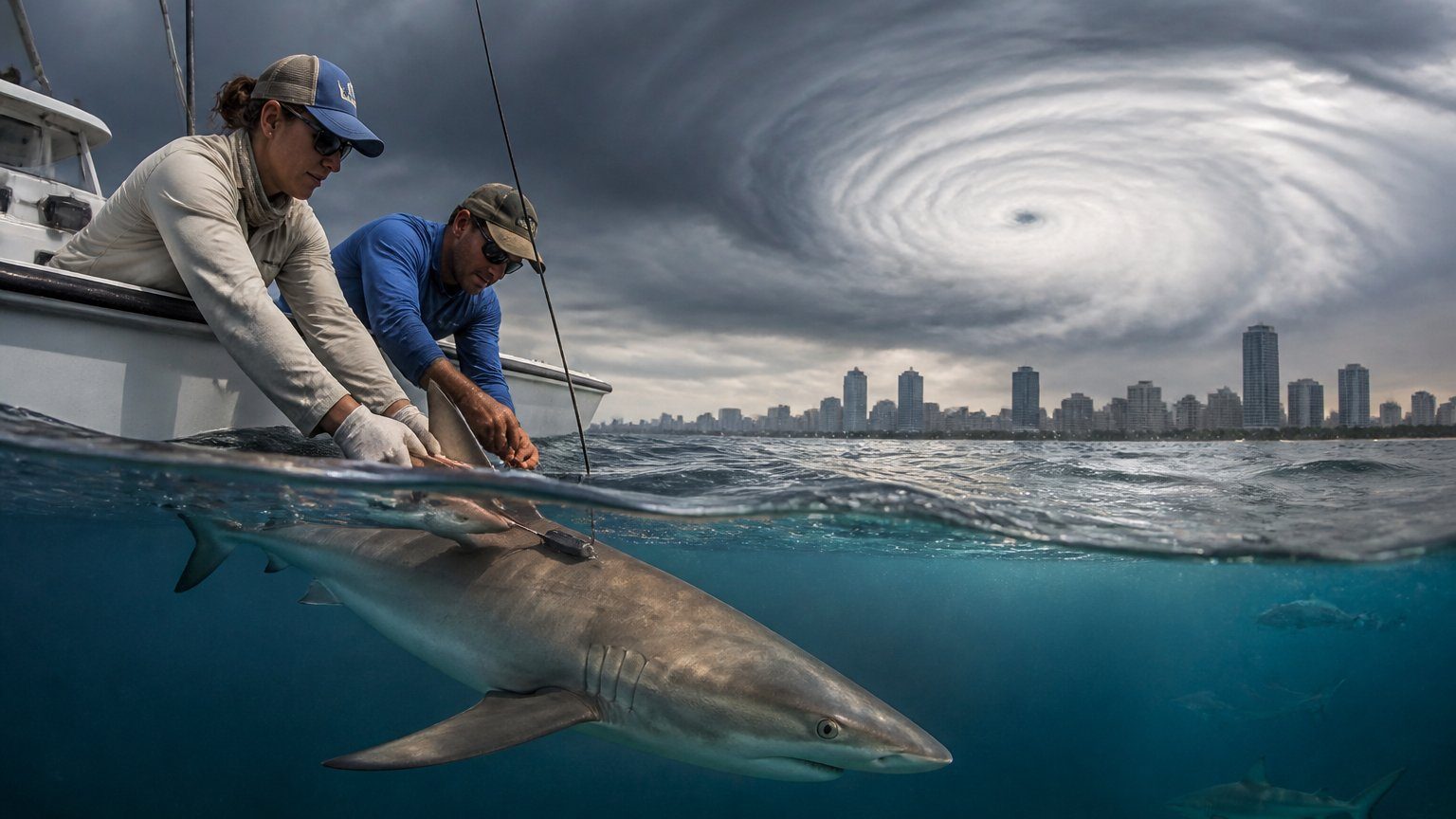
University of Delaware researchers are using shark tagging to track ocean conditions that can shape hurricane intensity along the East Coast.
University of Delaware researchers are turning to shark tagging in a bid to better predict hurricane intensity on the East Coast. This summer’s work focuses on using the animals as moving sensors to gather information from the Atlantic Ocean that is difficult and expensive to collect by other means.
The team is attaching electronic tags to sharks to record data such as ocean temperature and salinity. Those readings could help scientists understand the Mid-Atlantic’s cold pool, a layer of bottom water below 50 degrees Fahrenheit that forms in spring and fades in fall. Researchers say that water mass can influence how quickly a hurricane strengthens.
Aaron Carlisle, a UD marine scientist leading the project, said animal-borne sensors have been used for years in ocean research, especially on elephant seals in polar regions where observations are limited. His team has been working from the R/V Daiber, a university research vessel operated by the College of Earth, Ocean and Environment, to test whether sharks can serve a similar role in the Atlantic.
Until now, shark tagging has mostly been used to study migration routes and habitat use. For this project, scientists head 30 to 40 miles offshore, set baited lines and wait, sometimes as long as three hours, for a shark to bite. The work began in May, when sharks move closer to shore after leaving their winter habitats.
“University of Delaware researchers are using shark tagging to track ocean conditions that can shape hurricane intensity along the East Coast.”
The researchers say shortfin mako sharks, blue sharks, smooth hammerheads and juvenile great white sharks have been the best fit for the experiment because they surface often enough for the tags to send data to satellites. The tags are attached to the dorsal fin, and each time a shark swims near the surface, the device can relay information to orbiting satellite receivers.
Carlisle said the method does not harm the sharks. Each animal is checked first to make sure it is not stressed or injured, since either could affect the data. The tags are also made from materials that corrode over time and eventually drop away.
He said the warm top layer of the ocean is especially important because it helps drive hurricane intensity. “Warmer mixed layer equals stronger hurricane,” Carlisle said, explaining that the heat stored in that water feeds storms as they develop over the Atlantic.
Carlisle hopes the project will help people from North Carolina to Massachusetts prepare earlier for hurricanes and better understand the conditions that can shape a storm before landfall. He also wants the research to challenge the idea that sharks are only dangerous animals. As he put it, sharks are well adapted to ocean life and can provide valuable scientific insight, making the effort a practical win for both forecasting and conservation-minded education. For American families along the coast, the work matters because better ocean data could mean better warning when hurricanes start to intensify.
Frequently asked questions
What are the researchers using sharks to do?
They are attaching tags to Sharks to collect ocean temperature and salinity data. The goal is to better understand conditions that affect hurricane intensity.
Why are sharks useful for this study?
Certain species surface often enough for their tags to transmit data to satellites. That makes them practical moving sensors in the Atlantic.
What is the cold pool the team is studying?
It is a layer of bottom water under 50 degrees Fahrenheit that forms in spring and disappears in fall. Researchers say it can influence how fast Hurricanes intensify.
How are the sharks being tagged?
Scientists attach the tags to the dorsal fin after checking each shark’s health first. The tags are made to corrode and fall off later.
We value your privacy 🍪We use cookies for essential features and, if you allow it, to send you a notification whenever we publish a new story. See our Privacy Policy.
📨
Never Miss a Story
Get the headlines that matter delivered straight to your inbox.
📱 On iPhone: tap the Share icon, choose “Add to Home Screen”, then open TheTrueDefender from your Home Screen and tap 🔔 to turn on notifications. (Apple only allows notifications for saved web apps.)
🔔
Never miss a breaking storyGet free alerts the moment big US news breaks.
1Tap the ••• menu at the bottom of the screen, then tap Share(in Safari, just tap Share in the bottom bar directly)2Scroll down the menu and tap Add to Home Screen3Tap Add in the top-right corner4Open TheTrueDefender from your Home Screen, then tap 🔔 Subscribe and choose Allow
📱 Add TheTrueDefender to your home screen for one-tap access.