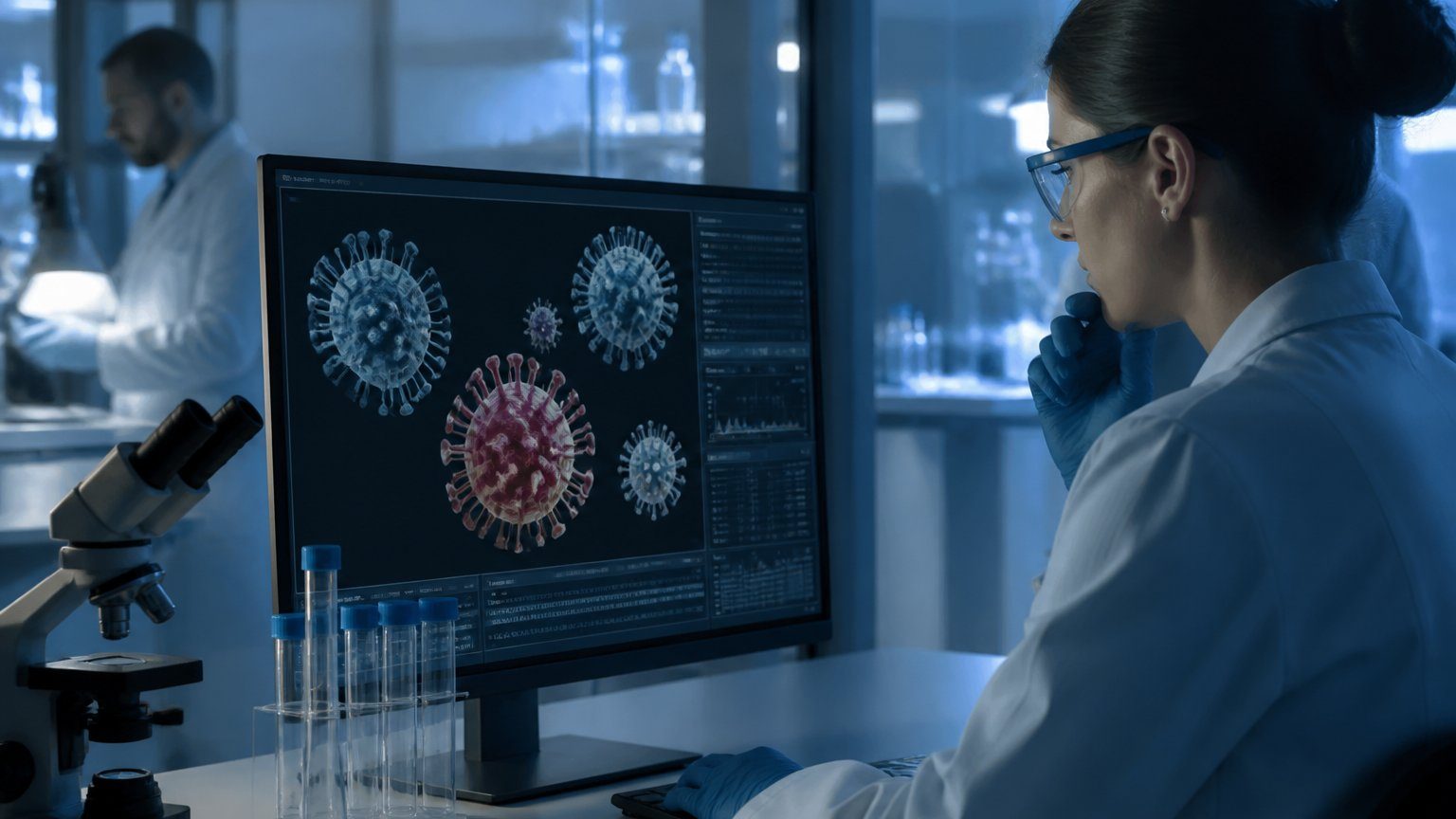
Artificial intelligence has designed new viruses with complete genomes for the first time, a lab breakthrough that could aid medicine and raise safety concerns.
Artificial intelligence has designed new viruses in a laboratory first, with US researchers reporting that AI-created genomes produced 16 working viruses that can reproduce and kill bacteria. The work marks the first time whole genomes have been successfully designed by AI, a step scientists say could open new paths for medicine while also sharpening concerns about misuse.
The viruses were bacteriophages, which infect only certain bacteria and do not threaten people. Researchers at Stanford University used AI models called Evo1 and Evo2, which were trained on genetic codes from viruses, bacteria, plants and people. They then refined the systems to generate phages, selected the most promising 302 designs, and synthesized them in the lab. Of those, 16 proved effective at killing E. coli.
Brian Hie, an assistant professor at Stanford, said the work pushed into new territory for generative AI. Samuel King, a PhD student in the lab, said the team realized the phages were working in the early hours of the morning when clear spots began appearing on petri dishes covered with bacteria. Hie said the room later burst into applause when the results were shared.
The immediate promise is medical. New phages could help develop treatments for infections that no longer respond well to antibiotics. Hie argued the broader potential of AI-designed biology could “massively improve human health” by supporting new drugs and therapies. The study also points to a wider shift in synthetic biology, where computer systems may increasingly be used to design biological functions rather than only analyze them.
“Artificial intelligence has designed new viruses with complete genomes for the first time, a lab breakthrough that could aid medicine and raise safety concerns.”
That promise comes with a warning. In a commentary published alongside the research in Science, Dr Thomas Inglesby and Dr Moritz Hanke of the Center for Health Security at Johns Hopkins University said the findings raise urgent biosafety and biosecurity questions. They said the issue is no longer whether generative viral genome design will exist, but whether it can be used without causing serious harm. They also said new viruses with the potential to cause disease should not be pursued.
The Stanford team said it took steps to reduce risk. The researchers excluded viruses that could infect complex organisms from the training data, worked only with phages instead of viruses that infect people, and carried out the experiments in a secure laboratory. Hie said those safeguards go a long way toward keeping the technology pointed in a useful direction.
The scale of what was achieved still matters. The phage genomes were around 5,400 base pairs long, far smaller than the roughly 500,000 base pairs in the smallest living cell and the three billion base pairs in the human genome. Hie said it would likely take a lot of work to move toward simple organisms, but he did not rule it out. That possibility is exactly why the research has drawn attention far beyond one lab. For Americans, the takeaway is clear: AI is now reaching into the building blocks of life, and the battle between medical breakthrough and biosecurity risk is only just beginning.
Frequently asked questions
What did researchers create with AI?
They designed complete genomes for 16 functional bacteriophages, which are viruses that infect bacteria. The phages were able to replicate in the lab and kill E. coli.
Why is this considered a first?
The researchers said it is the first time whole genomes have been successfully designed by AI. They described it as new territory for generative AI.
What medical use could this have?
The phages could help develop new treatments for infections that resist antibiotics. Researchers also said AI-designed biology could support new drugs and therapies.
What safety concerns did experts raise?
A Johns Hopkins commentary said the work raises urgent biosafety and Biosecurity questions. The authors warned the technology should not be used to create new viruses with disease potential.
We value your privacy 🍪We use cookies for essential features and, if you allow it, to send you a notification whenever we publish a new story. See our Privacy Policy.
📨
Never Miss a Story
Get the headlines that matter delivered straight to your inbox.
📱 On iPhone: tap the Share icon, choose “Add to Home Screen”, then open TheTrueDefender from your Home Screen and tap 🔔 to turn on notifications. (Apple only allows notifications for saved web apps.)
🔔
Never miss a breaking storyGet free alerts the moment big US news breaks.
1Tap the ••• menu at the bottom of the screen, then tap Share(in Safari, just tap Share in the bottom bar directly)2Scroll down the menu and tap Add to Home Screen3Tap Add in the top-right corner4Open TheTrueDefender from your Home Screen, then tap 🔔 Subscribe and choose Allow
📱 Add TheTrueDefender to your home screen for one-tap access.