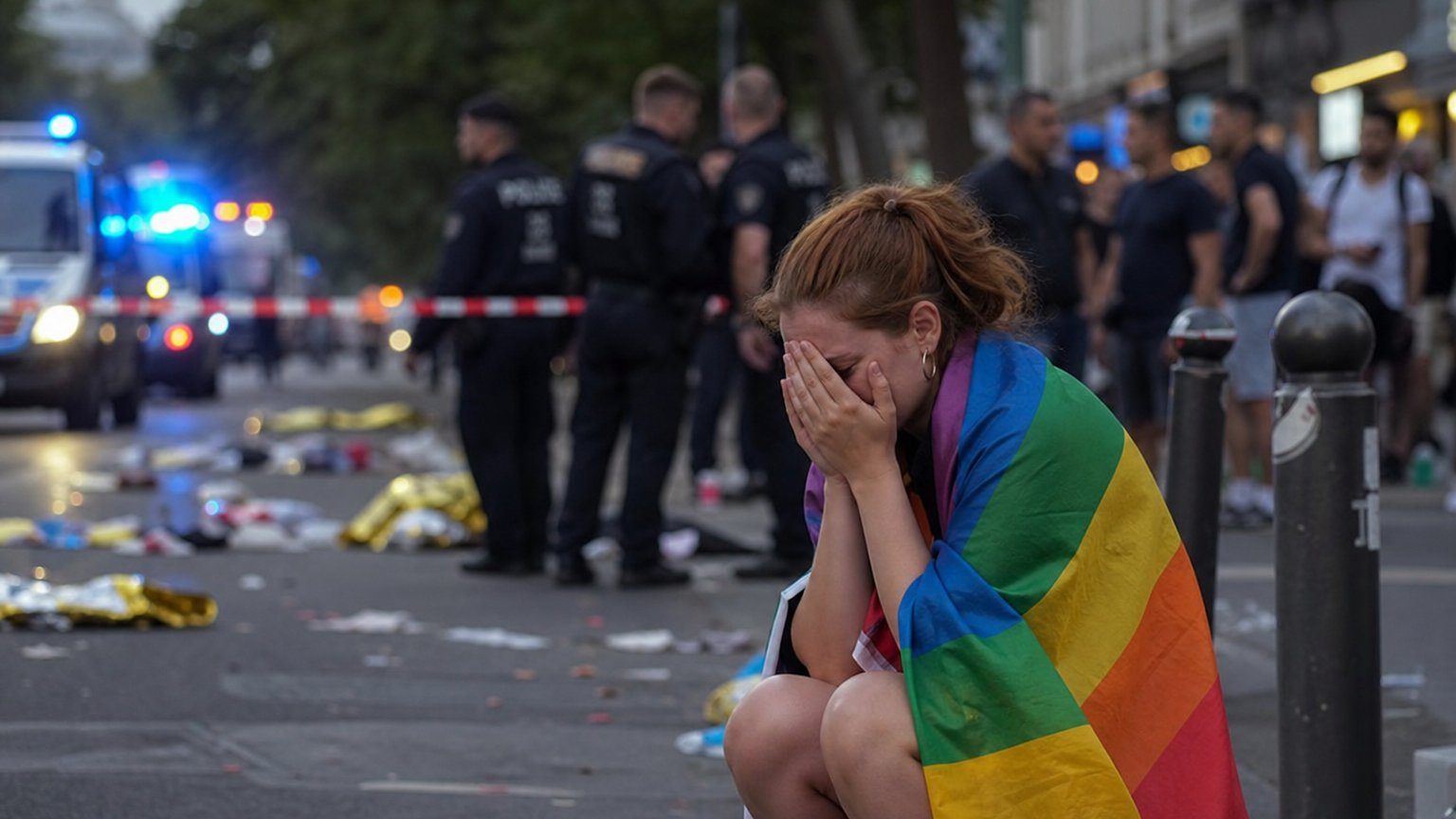
The Berlin Pride attack left one Polish woman dead and reignited anger in Germany, as officials ask why the suspect was free despite prior criminal cases.
The Berlin Pride attack has set off a new round of grief and anger in Germany, after officials raised sharp questions about why the suspect in the case was not already in prison. The attack on Saturday night left one Polish woman dead and at least twenty-nine other people injured, and the focus has quickly shifted to how authorities handled the man now identified as the main suspect.
The suspect, Abdul Ballout, was a twenty-one-year-old German citizen with Lebanese heritage. Police shot and killed him on Sunday. Germany’s Interior Minister Alexander Dobrindt said Ballout had previously stood out for a high number of criminal offenses, radicalization, and ties to the Islamist scene. As more details emerged about his record, the central question in the Berlin Pride attack has become a simple one: why was he not behind bars when the assault happened?
Prosecutors say Ballout tried in 2025 to join the Islamic State group’s armed struggle in Syria, traveling through Turkey to Lebanon. They say he met people there whom he believed were members of the group. He was arrested in Lebanon in July 2025 and sentenced to three months in prison for incitement to religious and sectarian conflict. When he returned to Germany in November 2025, he was arrested at Berlin Brandenburg Airport and held in pre-trial detention.
Ballout later faced a Berlin court, which in May handed down a juvenile sentence of one year and ten months for preparing a serious act of violence endangering the state. That sentence was suspended while prosecutors appealed, arguing for a tougher penalty. Ballout was then released and placed under the supervision of a probation officer. Dobrindt told RTL that the suspended sentence was “certainly incomprehensible” given the level of danger he believed the case showed, and said officials were looking into how that decision was made.
“The Berlin Pride attack left one Polish woman dead and reignited anger in Germany, as officials ask why the suspect was free despite prior criminal cases.”
Berlin’s Governing Mayor, Kai Wegner of the center-right Christian Democratic Union, also said he was stunned by the handling of the case. Speaking to RBB TV, he said the court had sentenced Ballout under juvenile criminal law and then issued a suspended sentence. Wegner said he would not judge the court’s decision because of judicial independence, but added that he was at a loss for words. The criticism has not been limited to the governing parties. The far-right Alternative for Germany described the attack as a total failure of security policy and demanded a thorough review of why a known Islamist threat was still free to move around.
Some of the debate has centered on what Ballout said before the attack and how he presented himself to people around him. According to Der Spiegel, he told the Berlin court this spring that he had distanced himself from extremist ideology and violence. Thomas Mücke, an extremism expert with the Violence Prevention Network, told ARD that he had met the suspect and that Ballout gave social workers a calm, careful, controlled, and friendly impression. Mücke said those are exactly the kinds of signals that can make it difficult to fully understand who someone is and what they may do next.
The Berlin Pride attack has also prompted broader calls for tougher terrorism laws and a closer look at Germany’s juvenile justice system. Peter Neumann of King’s College London told ZDF that Germany’s criminal law on terrorism is too lenient and that its sentences are short by European standards. He also called for a rethink of a juvenile system he said focuses on education more than protecting the public. Sebastian Fiedler, the home affairs spokesperson for the center-left Social Democrats, argued on Deutschlandfunk that the problem was not the law itself but how it was applied, saying there was a gap in the system after Ballout’s release.
Chancellor Friedrich Merz said it was too early to spell out the political consequences, but promised a response with both caution and determination. He said that if people classified as threats cannot be held, then their freedom of movement should be restricted as much as possible. He also said he had asked the interior ministry to review the law on monitoring jurisdiction. For Americans watching from afar, the case is a reminder that weak points in the handling of known security risks can carry deadly consequences, and that public safety depends on more than just arresting dangerous people after the fact.
Frequently asked questions
Who was the suspect in the Berlin Pride attack?
Police identified the suspect as Abdul Ballout, a 21-year-old German citizen with Lebanese heritage. Police shot and killed him on Sunday.
What was Ballout’s legal status before the attack?
He had been sentenced in May to one year and ten months in a juvenile court for preparing a serious act of violence endangering the state, but that sentence was suspended while prosecutors appealed. He was released and placed under probation supervision.
What prior actions by Ballout did prosecutors describe?
Prosecutors said he tried in 2025 to join the Islamic State group’s armed struggle in Syria, traveling through Turkey to Lebanon. They also said he was arrested in Lebanon and later held in pre-trial detention after returning to Germany.
What are officials saying after the attack?
Interior Minister Alexander Dobrindt and Berlin Mayor Kai Wegner both questioned how the case was handled. Other politicians and experts called for tougher terrorism laws, a review of juvenile justice, and better handling of known security risks.
We value your privacy 🍪We use cookies for essential features and, if you allow it, to send you a notification whenever we publish a new story. See our Privacy Policy.
📨
Never Miss a Story
Get the headlines that matter delivered straight to your inbox.
📱 On iPhone: tap the Share icon, choose “Add to Home Screen”, then open TheTrueDefender from your Home Screen and tap 🔔 to turn on notifications. (Apple only allows notifications for saved web apps.)
📱 Add TheTrueDefender to your home screen for one-tap access.