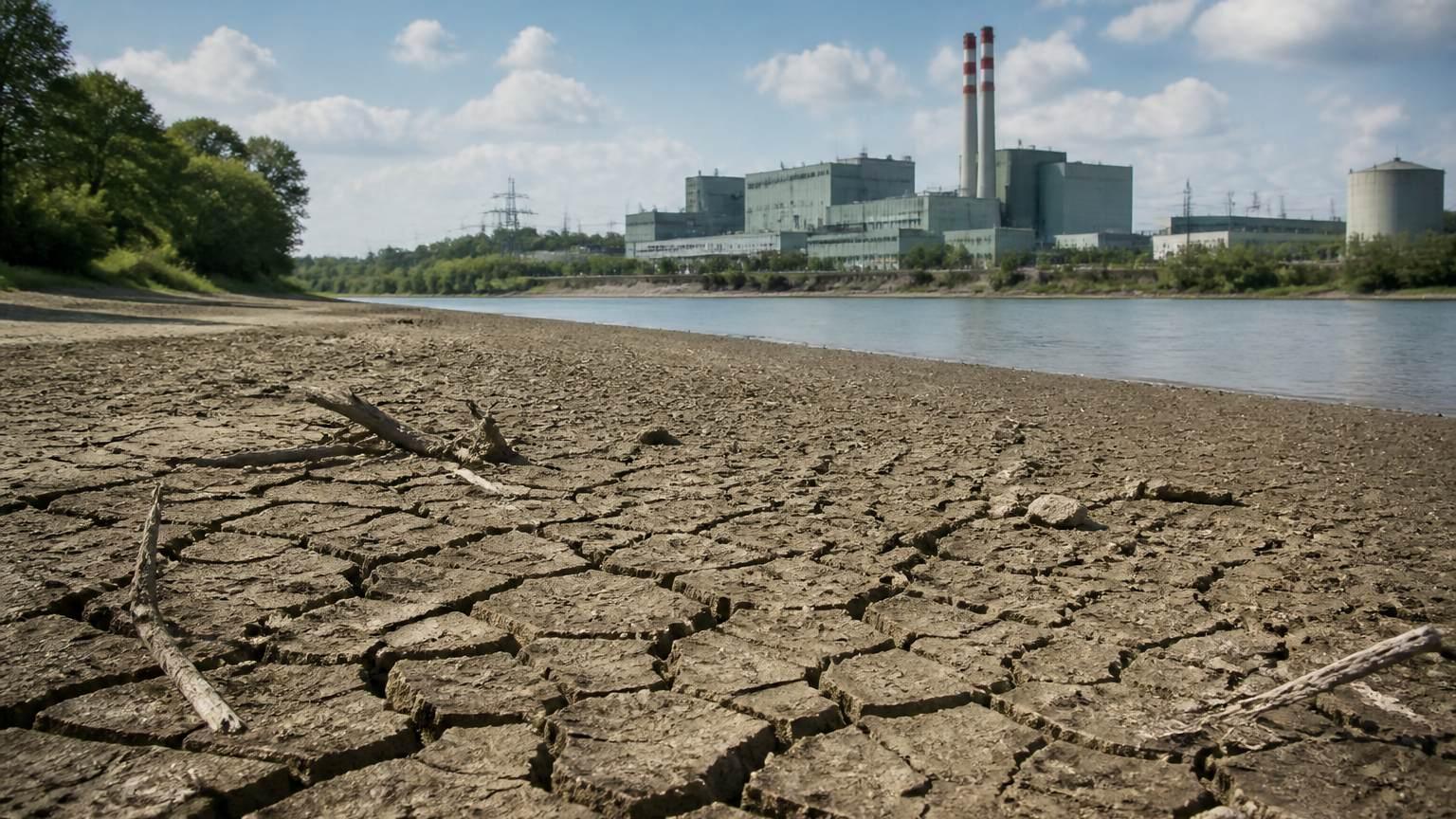
Danube low water has forced Hungary’s only nuclear plant offline, raising fresh energy concerns as a severe heatwave strains the grid.
Danube low water has forced Hungary’s only nuclear plant to shut down for the first time, a major blow to the country’s power system as a punishing heatwave grips the region. Prime Minister Péter Magyar said the Soviet-era Paks plant will have to go completely offline because the River Danube has fallen so far that its cooling system can no longer function properly.
The plant depends on the Danube for cooling, but officials say the water level is now too low for the suction nozzles to reach it. Magyar warned that Hungary’s energy supply could turn “critical” from Monday, with temperatures expected to hover around 37C for a week. He urged people to reduce electricity use during peak hours between 17:00 and 22:00, including by avoiding electric car charging and limiting air conditioning use.
Magyar also said a rotational shutdown regime could be introduced if voluntary restraint and other measures do not keep the national grid balanced. He added that the government would prepare a list of electricity and water consumers whose usage could be limited. The warning underscores how quickly a climate-driven water shortage can move from an environmental problem to a daily-life issue for households, businesses and public services.
The crisis in Hungary is part of a wider pattern across Europe. Much of the continent has faced low rainfall and high temperatures for much of the summer, and the Danube has dropped to its lowest levels in 30 years in several countries, including Serbia and Romania. Climate change is pushing temperatures higher around the world, and Europe is warming twice as fast as the global average, according to the Copernicus climate service.
“Danube low water has forced Hungary’s only nuclear plant offline, raising fresh energy concerns as a severe heatwave strains the grid.”
Romania is dealing with similar pressure. One of the country’s two reactors at the Cernavoda power plant was shut down earlier this week because the Danube had become too low, and state-owned Nuclearelectrica was trying to keep the second reactor running on Thursday. Cernavoda supplies about 20% of Romania’s power, so a second shutdown would leave the country temporarily without any nuclear energy production, just as Hungary now faces that same risk.
River transport is also being hit hard. Shipping has stopped on the Danube in Bulgaria, and border police evacuated 186 river cruise passengers from the Viking Ullur after it ran aground near Vidin. Passengers had been running low on food and water because the ship could not dock, and another vessel sent to help could not get close enough. Bulgaria’s maritime administration said it had never seen river levels this low in the years it has monitored them, with one official saying there has been nothing similar since 1990.
The effects are spreading beyond the main channel of the Danube. In Serbia, the Sava and Tisa, both tributaries of the river, are also running very low. Serbian hydrologist Dejan Vladiković said the problem is tied not only to the current heat but also to low rainfall in the spring, and he told Serbian TV that the Danube is at levels not seen for 50 to 60 years, with little improvement expected until mid-September. Temperatures in Serbia are forecast to reach as high as 38C on Friday, and locally up to 40C, with night-time temperatures in Belgrade reaching 26C.
The low water has even exposed unexpected finds, including the remains of a sunken Hungarian cargo ship in Croatia, hulks from a German river flotilla in Serbia, and bones in the Danube riverbed near Ruse in Bulgaria that experts identified as those of a mammoth. For Americans watching from afar, the big takeaway is clear: Europe’s heat and water stress is now powerful enough to disrupt energy, travel and trade all at once.
Frequently asked questions
Why did Hungary’s nuclear plant have to shut down?
The Paks plant depends on the Danube for cooling, but the river level has fallen too low for the suction nozzles to reach it. Officials said the plant will have to go completely offline.
How did Hungary respond to the power warning?
Prime Minister Péter Magyar urged people to cut electricity use during peak hours from 17:00 to 22:00. He specifically mentioned avoiding electric car charging and limiting air conditioning.
Is Romania facing a similar problem?
Yes. One of the two reactors at the Cernavoda plant was shut down earlier in the week because the Danube became too low. State-owned Nuclearelectrica was trying to keep the second reactor running.
What other impacts has the low Danube water caused?
Shipping has stopped on the Danube in Bulgaria, and 186 river cruise passengers were evacuated after the Viking Ullur ran aground near Vidin. Low water has also affected the Sava and Tisa in Serbia.
We value your privacy 🍪We use cookies for essential features and, if you allow it, to send you a notification whenever we publish a new story. See our Privacy Policy.
📨
Never Miss a Story
Get the headlines that matter delivered straight to your inbox.
📱 On iPhone: tap the Share icon, choose “Add to Home Screen”, then open TheTrueDefender from your Home Screen and tap 🔔 to turn on notifications. (Apple only allows notifications for saved web apps.)
📱 Add TheTrueDefender to your home screen for one-tap access.