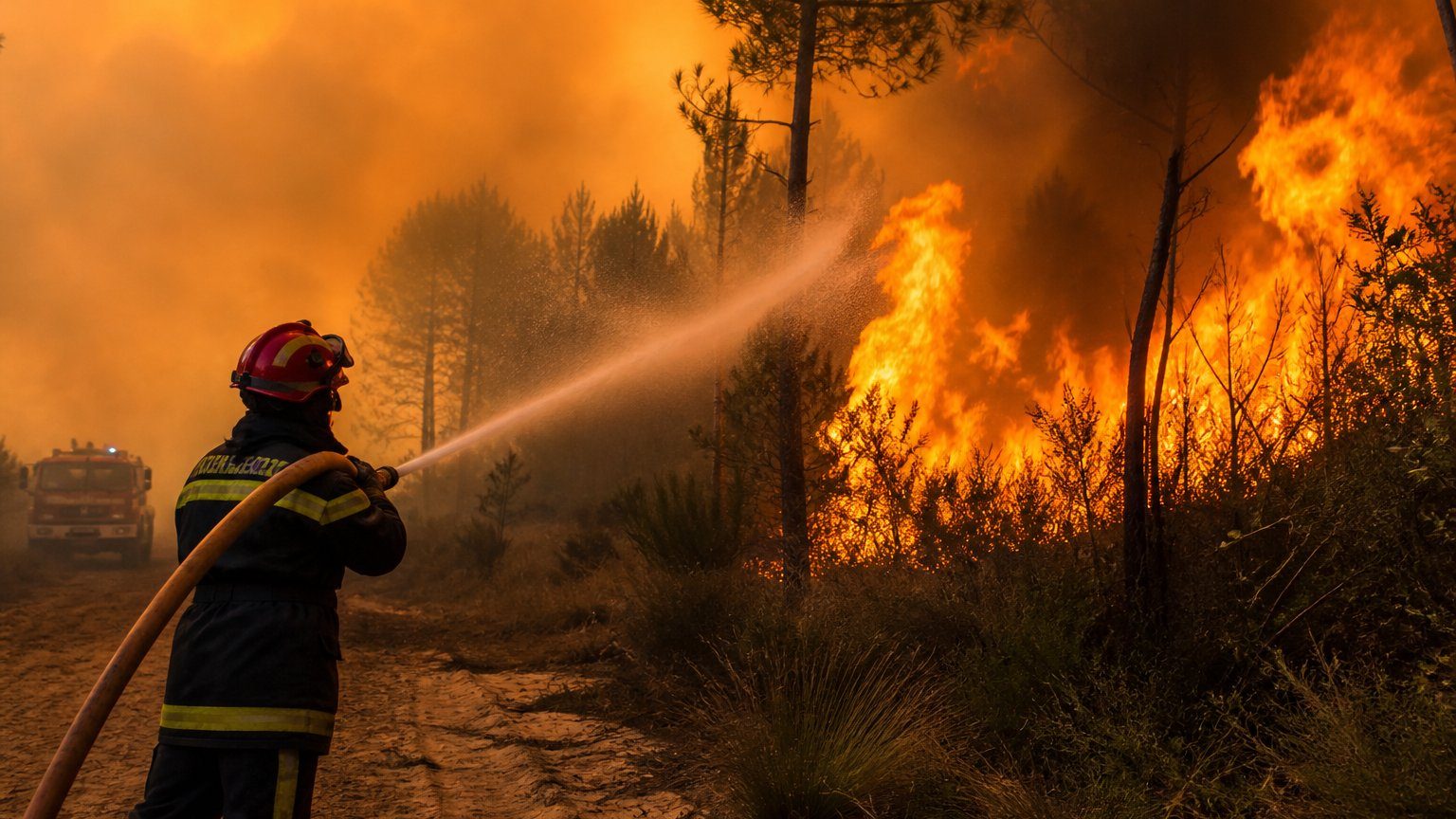
France wildfire crews in Gironde are battling fresh flare-ups as temperatures near 40C, while some residents have refused evacuation orders.
France wildfire crews are racing to hold back the Gironde wildfires as fresh flare-ups break out under temperatures near 40C, turning the south-west region into an exhausting contest of speed, smoke and containment. The fire battle in Gironde has now drawn thousands of firefighters and volunteers, with officials urging people in threatened areas to leave even as some residents stay behind to protect their homes.
From the air, Canadair aircraft and helicopters have been central to the response. The planes flew in formation over thick smoke, dropping more than 1,000 gallons of water at a time, while helicopters followed with streams of fire retardant. Once the smoke thinned, firefighters moved on foot into the forest to work on the latest flare-up. The pattern has repeated again and again: knock one fire down, then rush to the next one before it spreads.
That cycle has made the Gironde wildfire battle feel less like a single fire and more like a moving frontline. Crews face a landscape of dry soil, pinecones and dead leaves that has helped the flames travel fast. As smoke drifted across empty roads and deserted villages west of Bordeaux, officers warned people to leave when conditions worsened. In one moment described on the ground, a flare-up was brought under control only for another to appear on the other side of the road.
Some residents have resisted evacuation orders. Pierre Alexandre said he refused to leave when police told him to go, even though the fire began in the woods beside his bungalow. He later showed a photo of himself sitting on his roof in the dark, though he said it was taken in the afternoon after he had told his wife and daughter to leave. His 19-year-old son stayed too, after Alexandre gave him the choice.
“France wildfire crews in Gironde are battling fresh flare-ups as temperatures near 40C, while some residents have refused evacuation orders.”
For many others, the effort is now a mix of duty and desperation. Volunteer Hugo, 26, described the work as a struggle to save what can still be saved, saying that if it is too late, at least they tried. He pointed to the scale of the damage already done, saying 50,000 hectares has been destroyed. Maëlys, 23, who works as a nurse, said she spends her mornings at the hospital and her afternoons in the forest helping with the firefighting effort. She described the situation as devastating for the region, the woods and the families who live there.
Crews have arrived from across France, including Brittany, Marseille and Lyon, to support the operation in the southwest. When they are not directly spraying flames, they water soil and vegetation to slow the spread of future outbreaks. The technique is known as “noyer,” a French term that means drowning, and it reflects how this fire fight is being waged: not by defeating every blaze at once, but by stopping the next one before it grows.
The Gironde wildfire battle shows how quickly heat, dry ground and stubborn flare-ups can overwhelm local communities, and why evacuation orders matter when fire crews are already stretched thin. For Americans watching from afar, it is a reminder that extreme fire conditions can push even well-equipped regions into crisis, with ordinary residents forced to choose between safety and home.
Frequently asked questions
What is making the Gironde wildfire so hard to control?
Fresh flare-ups keep appearing in dry conditions, and crews have to move quickly from one hotspot to the next. Heat, dry soil, pinecones, and dead leaves are helping the flames spread fast.
What firefighting methods are being used?
Canadair aircraft drop large amounts of water, helicopters spread fire retardant, and ground crews attack flare-ups on foot. Crews also water soil and vegetation to help prevent new outbreaks.
Are people leaving the threatened areas?
Officials are urging evacuations when conditions worsen, and some residents have left. Others, however, have refused to go and stayed to protect their homes.
How much area has been destroyed?
A volunteer firefighter said 50,000 hectares has been destroyed. The article does not give an official damage total beyond that figure.
We value your privacy 🍪We use cookies for essential features and, if you allow it, to send you a notification whenever we publish a new story. See our Privacy Policy.
📨
Never Miss a Story
Get the headlines that matter delivered straight to your inbox.
📱 On iPhone: tap the Share icon, choose “Add to Home Screen”, then open TheTrueDefender from your Home Screen and tap 🔔 to turn on notifications. (Apple only allows notifications for saved web apps.)
📱 Add TheTrueDefender to your home screen for one-tap access.