⚡ LATEST
Jodrell Bank Telescope Cut Sparks Science Alarm

Jodrell Bank Telescope Cut Sparks Science Alarm

The Jodrell Bank telescope funding cut could shut down science at the Cheshire observatory by April 2028, alarming astronomers and training experts.

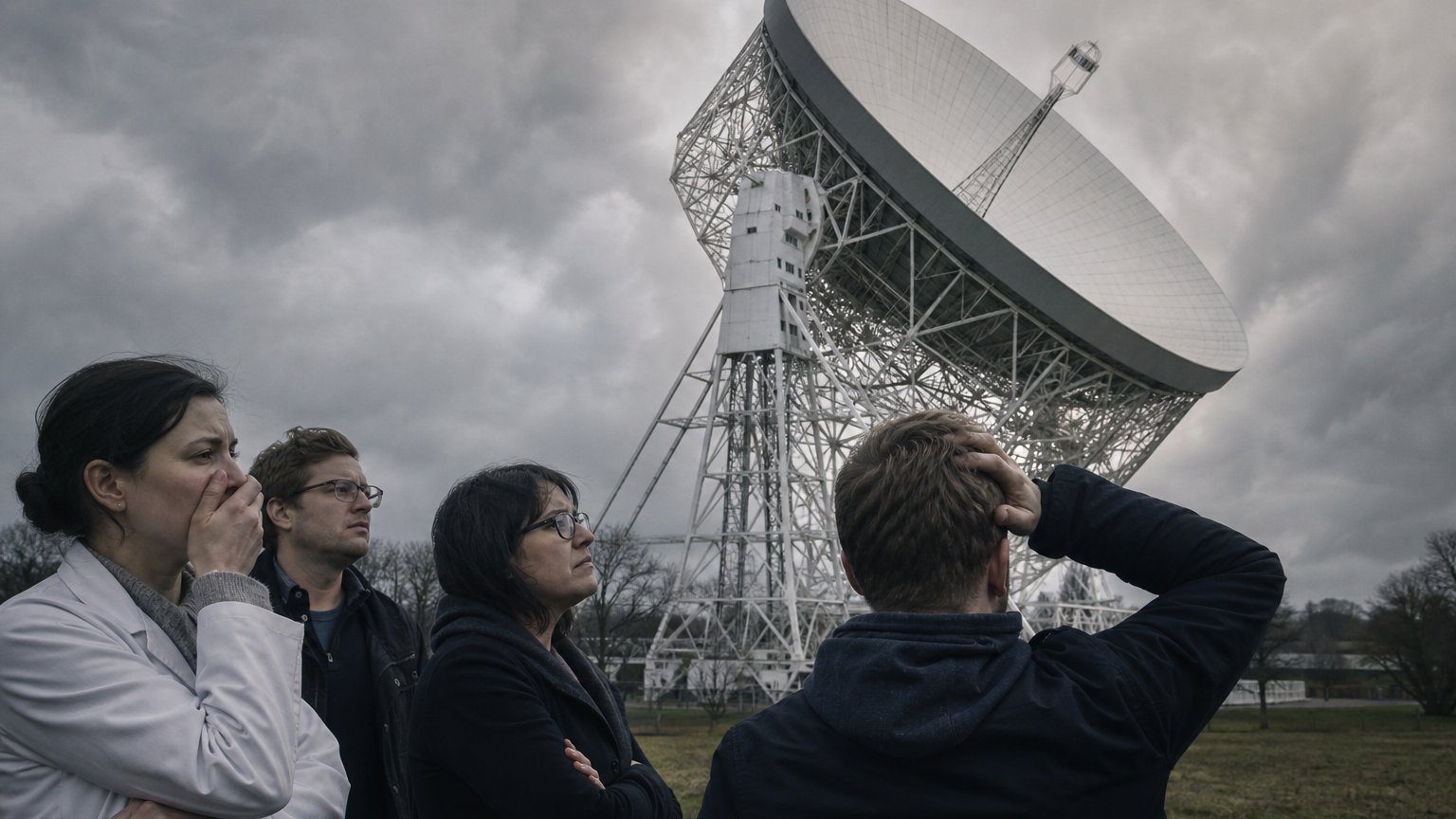
The Jodrell Bank telescope funding cut has put one of Britain’s most important science sites on course for possible closure by April 2028, triggering sharp warnings from astronomers who say the move could weaken UK research for years to come. The observatory in Cheshire, home to the country’s largest telescope for nearly seven decades, has lost its funding, and the BBC understands all scientific observations are now expected to stop on 1 April 2028 unless other money is found.

Scientists connected to the site say the decision goes far beyond one observatory. Jodrell Bank and its telescope network have helped drive the study of distant galaxies and have trained generations of astronomers. Prof Brian Cox, of the University of Manchester, called the cuts “hasty and ill-considered,” while describing the damage to the UK science base as already significant. He said he was surprised UKRI was pressing ahead instead of working with the Burnham government on a fix.

UK Research and Innovation, the funding body behind the decision, said it had to direct money toward projects with the strongest long-term impact. It said the observatory’s annual budget of £2.8 million had to be cut because planned research costs for physics and the running of its laboratories had climbed. The agency, which manages an annual budget of just under £10 billion, said the choice was part of wider reductions across astronomy, nuclear and particle physics over the next four years.

Jonathan Reynolds, the new Secretary of State in the expanded business department now responsible for science, said the UK’s research strength is central to building a better future. He said he was committed to working with UKRI so Britain can both maintain world-leading research and invest in the next generation of scientific facilities and infrastructure. That exchange captures the bigger fight now unfolding: whether the country should protect a historic research asset or concentrate limited funds elsewhere.

Jodrell Bank has deep roots in British science. Established in 1945, it helped pioneer radio astronomy and the study of galaxies beyond our own. During the Cold War, it also played a role in monitoring Soviet missiles at a time of high nuclear tension. Its contribution to global science earned it Unesco World Heritage status in 2019, a distinction that underscored its value well beyond campus boundaries.
The observatory’s reach is larger than the Cheshire site itself. The Lovell Telescope, which sits at the heart of Jodrell Bank, remains one of the world’s most capable steerable radio telescopes. Connected with six other telescopes across central England through the e-Merlin network, it can study deep-space objects in remarkable detail, with resolution compared to the Hubble space telescope. Researchers use that network to explore how galaxies evolve, how supermassive black holes shape them, and the nature of dark matter and dark energy.

Prof Simon Garrington, associate director of the observatory, said staff were devastated and warned that 28 jobs are at risk. He also said the closure would affect the work of nearly 3,000 scientists who rely on the site in their research. Garrington said the observatory has been a national capability for nearly 70 years and a beacon for science in the north-west of England, helping draw young people into science and engineering careers. He said the decision would be challenged, but if that failed, the leadership would look for alternative funding to keep the Lovell Telescope operating in some form.

Researchers also say the cuts come at the wrong moment for radio astronomy worldwide. Other countries are investing in their own observatories as the Square Kilometre Array in South Africa and Australia moves toward coming online in the coming years. Prof Michael Kramer called UKRI’s move scientifically, technologically and economically short-sighted, while Scotland’s Astronomer Royal, Prof Catherine Heymans, called it a real act of national self-harm. The wider lesson for American readers is plain: when a country backs away from core scientific infrastructure, it can lose not only prestige but also the pipeline that trains the next generation of discovery-minded researchers.

Frequently asked questions

When could Jodrell Bank stop scientific observations?
The BBC understands observations are expected to stop on 1 April 2028 unless other funding is secured.
Why did UKRI cut Jodrell Bank’s funding?
UKRI said it had to direct money toward projects with the strongest long-term impact and cut the observatory’s £2.8 million annual budget because research and laboratory costs had risen.
How many jobs are at risk?
Prof Simon Garrington said 28 jobs are at risk.
What makes Jodrell Bank scientifically important?
Founded in 1945, it helped pioneer radio astronomy, and its Lovell Telescope and e-Merlin network are used to study galaxies, black holes, dark matter, and dark energy.

More from Politics

View all →
📨

Never Miss a Story

Get the headlines that matter delivered straight to your inbox.