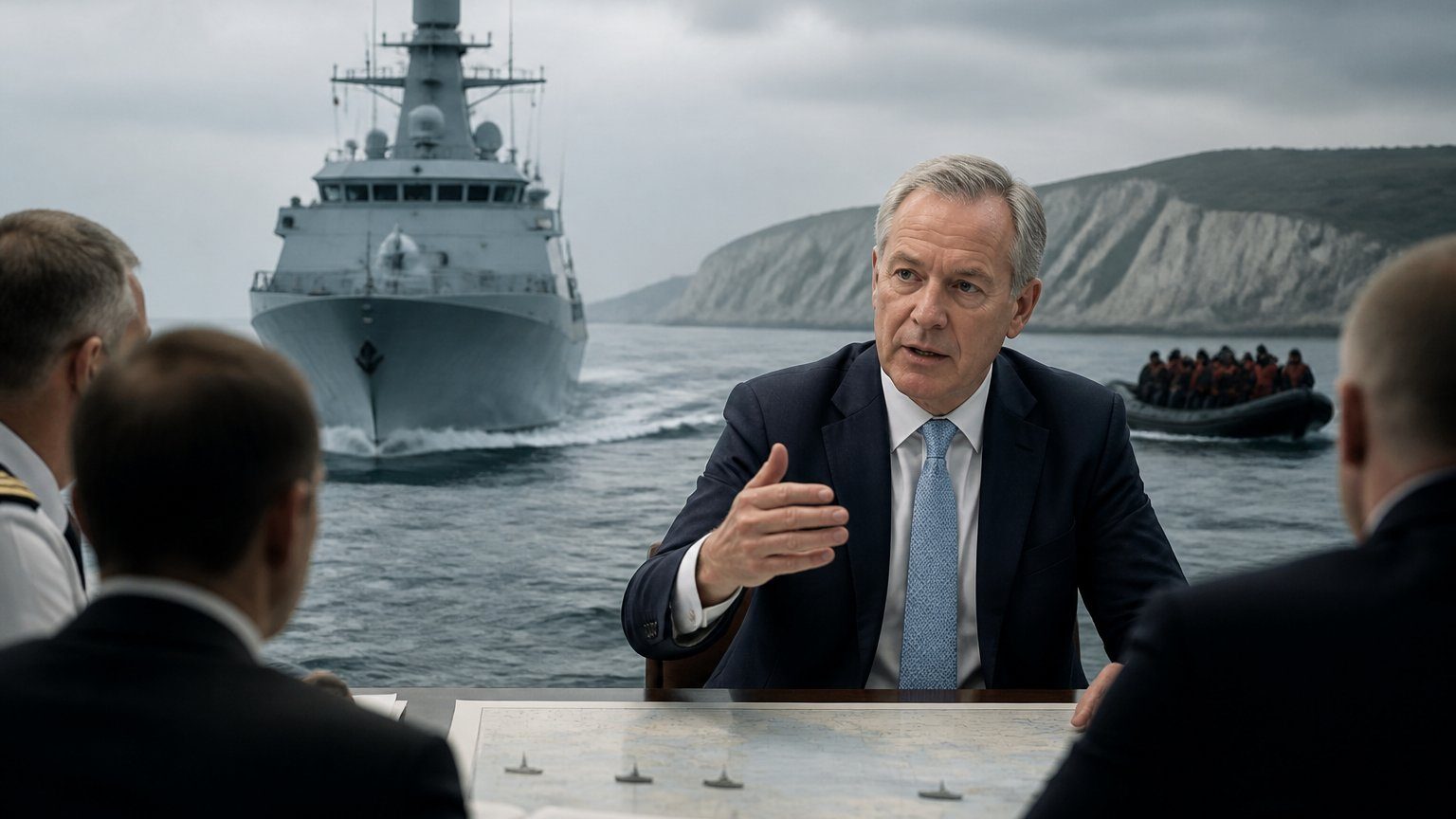
Reform UK says it would use Royal Navy vessels to stop small boat crossings in the English Channel and send migrants back to France or Belgium.
Reform UK says it would deploy the Royal Navy to intercept small boat crossings in the English Channel if it wins the next government, in a proposal the party says would amount to the largest military operation in the Channel since World War Two. The plan, due to be unveiled at a news conference later, would have naval vessels stop migrant boats and return them to France or Belgium.
Home affairs spokesman Zia Yusuf said the operation would be a humanitarian response and argued it could be carried out under the European Convention on Human Rights. He also said the plan, called Operation Fortress, has backing from former senior members of the armed forces. Asked whether migrants could be sent back without French agreement, Yusuf said he believed it would be possible, though he acknowledged there could be a diplomatic dispute if France refused to take them.
The proposal lands in the middle of a wider political fight over how to handle Channel crossings. Energy Secretary Miatta Fahnbulleh said the government would need to spend a lot of time arguing with France if such a plan were attempted. She said the current government needs to get a grip on small boat crossings, while adding that it is already cracking down on criminal gangs and boosting enforcement. The prime minister, who visited Dover at the weekend, said the government was changing its approach as enforcement officers working against people-smuggling gangs increased on both sides of the Channel.
Official figures show the scale of the challenge remains large even as crossings have fallen. Between 1 January and 1 August 2026, 14,526 people crossed the English Channel by small boat from France. That was around 43% lower than the same period the previous year. The Home Office also said 326 people crossed on Saturday, pushing the number of small boat arrivals since the prime minister took office a fortnight ago past 2,000.
“Reform UK says it would use Royal Navy vessels to stop small boat crossings in the English Channel and send migrants back to France or Belgium.”
Those figures sit alongside a broader shift in enforcement. The Home Office said the number of National Crime Agency officers targeting smuggling gangs involved in small boat crossings had risen to almost 800, from 376 at the start of 2025. The government says its goal is to smash the gangs behind the crossings, while also trying to reduce the incentives for dangerous journeys.
Reform UK’s proposal would move the Royal Navy into a role usually handled by border authorities, and that drew scepticism from retired Royal Navy commander Tom Sharpe. He said the border force is better suited to managing migrant arrivals and argued that warships built for jobs such as anti-submarine defence are not the right tool for ferrying people around. His criticism points to a basic practical question at the heart of the plan: whether a military response can replace, or even work alongside, the civilian and diplomatic machinery normally used for migration control.
Conservative shadow home secretary Chris Philp set out a different response, saying the priority should be leaving the European Convention on Human Rights. He argued that doing so would allow the government to deport every illegal immigrant within a week of arrival, either to their country of origin or to a safe third country such as Rwanda. He said that would create a deterrent effect and discourage future crossings.
The Channel route has become the main way people are detected entering the UK illegally since 2020, and nearly all small boat arrivals claim asylum once they land. Under international law, that means they are allowed to stay while claims are considered. Small boat arrivals accounted for 42% of asylum applications between April 2025 and March 2026, and boats that arrived between 2 August 2025 and 1 August 2026 carried an average of 67 people, more than double the average in 2021. With the crossings still feeding the asylum system and political debate on both sides, the fight over the English Channel remains one of the clearest tests of how Britain wants to control its borders. The bottom line for American readers: Britain’s Channel crisis shows how migration, law, and border enforcement collide when governments try to stop irregular arrivals without a shared international solution.
Frequently asked questions
What is Reform UK proposing for Channel crossings?
The party says it would use Royal Navy vessels to stop small boats in the English Channel and send migrants back to France or Belgium.
How many people have crossed the Channel this year?
Between 1 January and 1 August 2026, 14,526 people crossed by small boat from France, according to Home Office figures.
What did Reform UK say about legal concerns?
Zia Yusuf said the plan could work under the European Convention on Human Rights and said the UK and France might end up in a diplomatic dispute.
How is the current government responding?
The government says it is cracking down on criminal gangs and boosting enforcement, including a rise in National Crime Agency officers targeting smuggling networks.
We value your privacy 🍪We use cookies for essential features and, if you allow it, to send you a notification whenever we publish a new story. See our Privacy Policy.
📨
Never Miss a Story
Get the headlines that matter delivered straight to your inbox.
📱 On iPhone: tap the Share icon, choose “Add to Home Screen”, then open TheTrueDefender from your Home Screen and tap 🔔 to turn on notifications. (Apple only allows notifications for saved web apps.)
🔔
Never miss a breaking storyGet free alerts the moment big US news breaks.
1Tap the ••• menu at the bottom of the screen, then tap Share(in Safari, just tap Share in the bottom bar directly)2Scroll down the menu and tap Add to Home Screen3Tap Add in the top-right corner4Open TheTrueDefender from your Home Screen, then tap 🔔 Subscribe and choose Allow
📱 Add TheTrueDefender to your home screen for one-tap access.