A SpaceX rocket collision with the Moon is expected Wednesday, giving scientists a rare chance to study the blast and fresh crater.
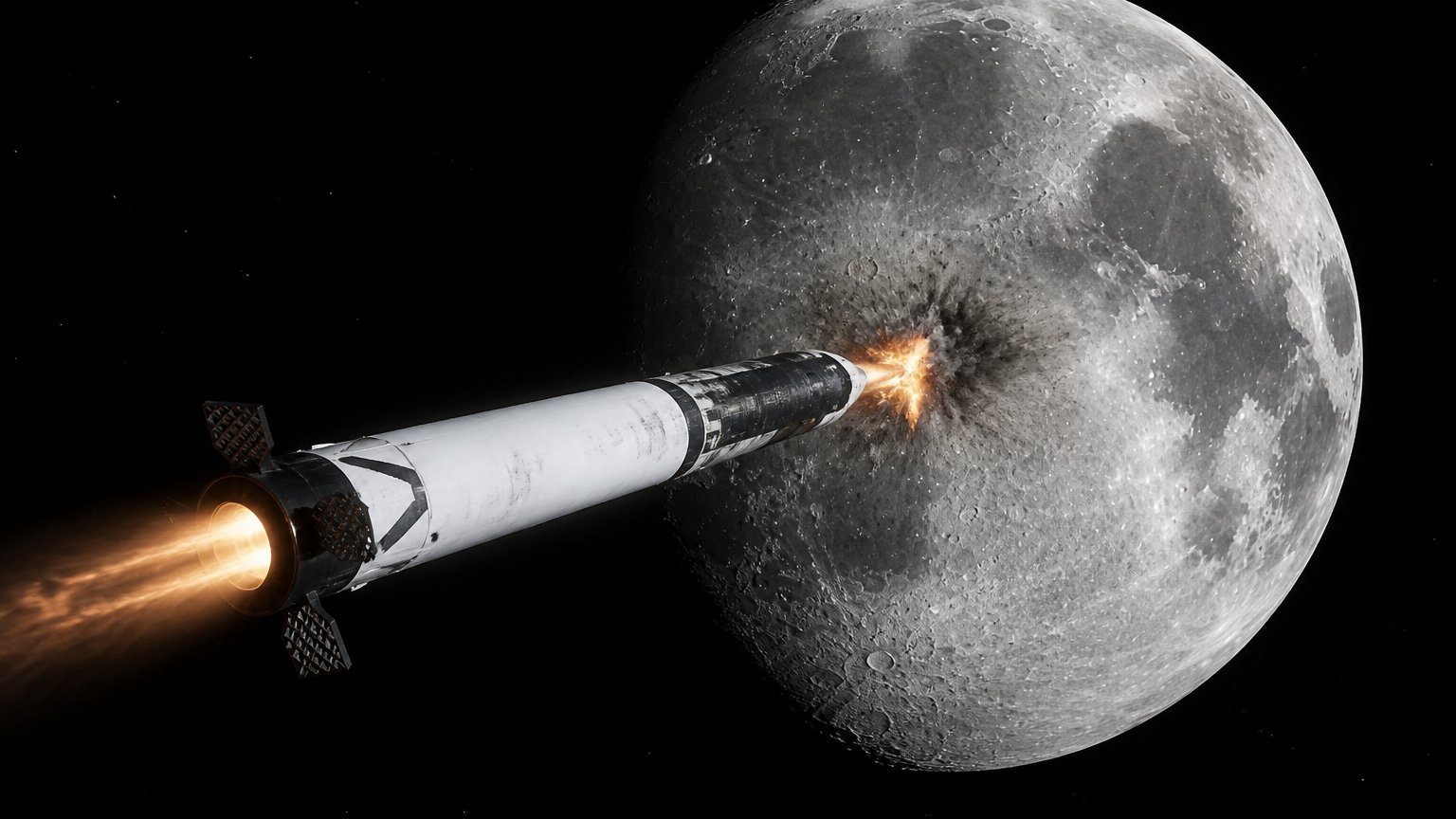
A SpaceX rocket collision with the Moon is expected on Wednesday, and astronomers say the impact could offer a rare scientific payoff. The upper stage of a Falcon 9 rocket is projected to strike the lunar surface at about 02:35 EDT, with the event visible to telescopes but not to the naked eye on Earth.
Nasa’s Centre for Near-Earth Object Studies said the rocket stage is on course to hit the Moon after independent astronomers used public data to trace its path back to a January 2025 launch. Spokesperson Jimi Russell said there is no danger to Earth and that Nasa will keep tracking the booster for training and later study the impact site for science.
The rocket segment was part of a US and Japanese mission that carried lunar landers and scientific equipment to the Moon last year. While SpaceX designs part of the Falcon 9 to return for reuse, the upper stage is left behind in space and can remain in orbit until it meets another object. In this case, that object is the Moon.
Astronomer Bill Gray, who first identified the trajectory, says the Moon collision should occur near Einstein Crater on the side of the Moon that faces Earth. He expects the strike to carve out a crater more than 17 metres across. Dr Matt Bothwell, a public astronomer at the University of Cambridge, said the event will not threaten anyone on Earth, but it will be worth watching.
“A SpaceX rocket collision with the Moon is expected Wednesday, giving scientists a rare chance to study the blast and fresh crater.”
Bothwell said the impact should throw up a large dust plume and produce a flash that might be picked up by powerful telescopes. He noted that the Moon’s lack of atmosphere means nothing will slow the object the way Earth’s air would, making the collision far more dramatic than a comparable event here. The Moon is also expected to loft material high above the surface, with debris then spreading outward over time.
Scientists plan to observe the blast closely. Big telescopes in the Americas, along with Nasa’s Lunar Reconnaissance Orbiter and South Korea’s Danuri probe, are expected to track the flash, the dust cloud and the new crater. A citizen-science project is also recruiting amateur observers to record the event, turning an accidental crash into a live experiment.
Researchers hope the Moon collision will improve models of how impacts work and reveal more about the material beneath the lunar surface. By watching how much matter is thrown up, how high it rises and how it falls back, scientists can learn more about the Moon’s makeup. The event also highlights a growing concern on Earth: the build-up of human-made space debris that remains in orbit long after launch.
That concern is not abstract. The European Space Agency says around 54,000 objects larger than 10 centimetres are floating in space, and humans have launched about 17,000 tonnes of material into orbit since the Space Age began in 1957. The last dead rocket to hit the Moon did so in 2022, when a Chinese Long March 3C upper stage struck the far side. For American readers, this is a reminder that space is becoming busier, and what we leave behind can still make headlines millions of miles away.
Frequently asked questions
When is the SpaceX rocket expected to hit the Moon?
The impact is expected at about 02:35 EDT on Wednesday, or 06:35 GMT.
Will the collision threaten Earth?
No. Nasa spokesperson Jimi Russell said there is no danger to Earth.
What will scientists learn from the impact?
They hope to study how much material is thrown up, how high it rises and what it reveals about the Moon’s subsurface.
Who will be watching the event?
Telescopes in the Americas, Nasa’s Lunar Reconnaissance Orbiter, South Korea’s Danuri probe and amateur observers will track it.
We value your privacy 🍪We use cookies for essential features and, if you allow it, to send you a notification whenever we publish a new story. See our Privacy Policy.
📨
Never Miss a Story
Get the headlines that matter delivered straight to your inbox.
📱 On iPhone: tap the Share icon, choose “Add to Home Screen”, then open TheTrueDefender from your Home Screen and tap 🔔 to turn on notifications. (Apple only allows notifications for saved web apps.)
🔔
Never miss a breaking storyGet free alerts the moment big US news breaks.
1Tap the ••• menu at the bottom of the screen, then tap Share(in Safari, just tap Share in the bottom bar directly)2Scroll down the menu and tap Add to Home Screen3Tap Add in the top-right corner4Open TheTrueDefender from your Home Screen, then tap 🔔 Subscribe and choose Allow
📱 Add TheTrueDefender to your home screen for one-tap access.