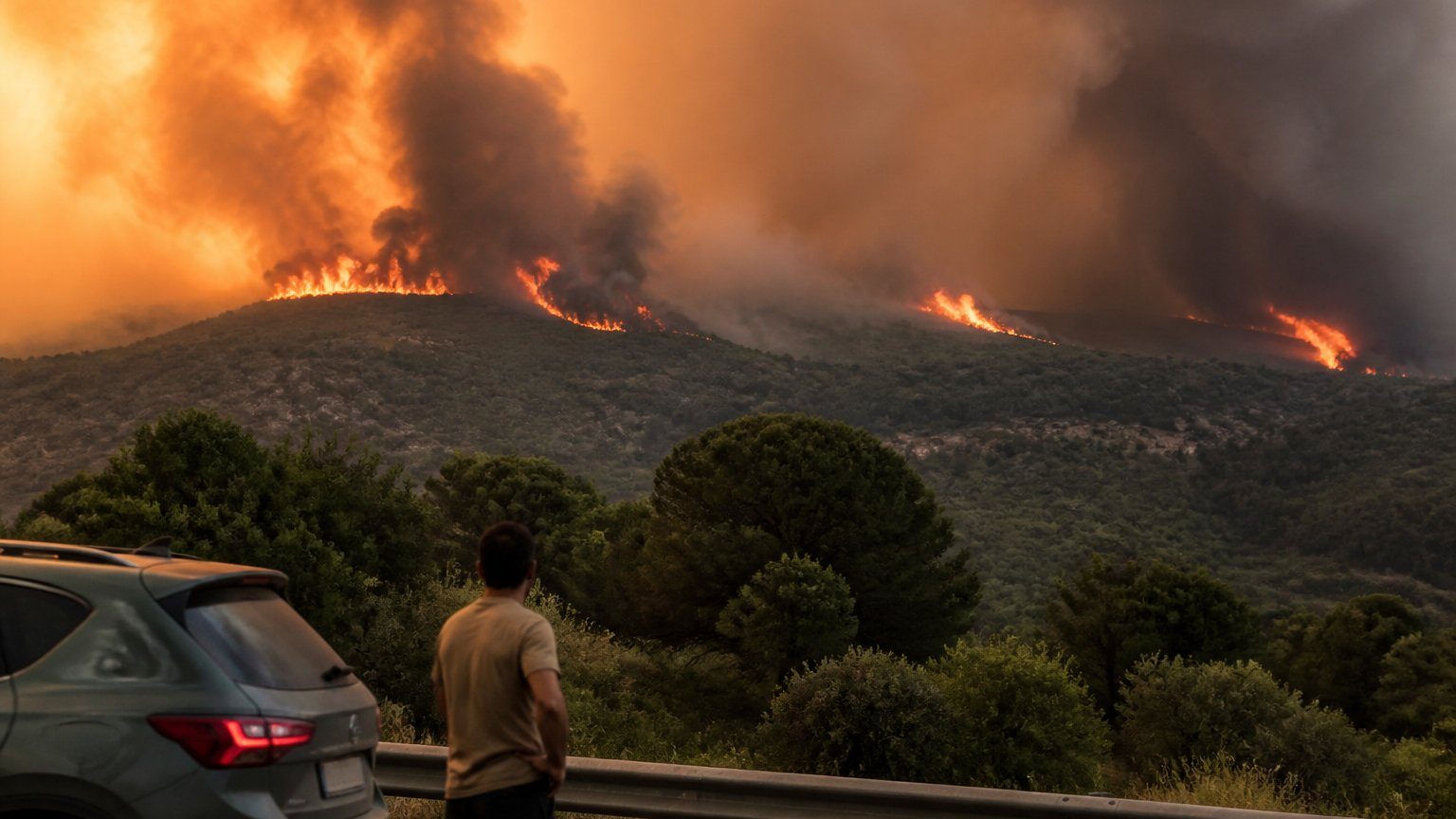
Spain wildfire crews are racing a new heatwave as evacuations ease in some areas, while fresh burn fronts keep Spain, France, Portugal and Greece on alert.
The Spain wildfire crisis is still moving on several fronts as crews race a new heatwave and officials in parts of Europe brace for more flare-ups. In Spain, some evacuees have been allowed to go home, but firefighters are still trying to keep major blazes from reigniting under hotter, drier conditions. At the same time, Greece, France, Portugal and Turkey are all dealing with active fires or the risk of renewed spread.
In Greece, three firefighters have died while battling wildfires in Crete and the Peloponnese. Two died in the Rethymno region of western Crete after becoming trapped as flames moved through the area. A third firefighter was found unconscious near the southern Peloponnese port town of Gytheio and later died. On Crete, strong winds pushed the fire through several villages and forced residents and tourists out of Krya Vrysi. Witnesses said the fire front stretched as far as 15 kilometers, or 9.3 miles.
Residents described a fast-moving and dangerous scene. Chrissa Gioukaki, speaking to Reuters, said the wind was so strong people could not stand at times and that the flames were huge. Other fires have also broken out on the Greek islands of Paros and Lesbos, as well as in the mainland town of Trifylia. In southern Turkey, a highway between Fethiye and Antalya was closed and part of a hospital was evacuated after fire spread in Muğla province.
The Spain wildfire front remains a major concern near Madrid. Prime Minister Pedro Sánchez said the next 12 hours would be decisive in the effort to control a fire near the capital. He said conditions were improving, but only with maximum caution, because of higher temperatures, lower humidity and the chance of gusts of wind. Fire officials said the blaze at Burgohondo in Ávila province, about 150 kilometers, or 93 miles, west of Madrid, has burned more than 43,000 hectares. It is now described as the largest recorded wildfire in Spanish history. Across Spain this year, more than 207,000 hectares have burned.
“Spain wildfire crews are racing a new heatwave as evacuations ease in some areas, while fresh burn fronts keep Spain, France, Portugal and Greece on alert.”
Fire crews are also watching for rekindling even where the flames appeared to ease overnight. Francisco Bolaños, who is helping direct firefighting operations, said the fire had not moved during the night but could flare again once temperatures rise. He said the priority is to stabilize a perimeter of 180 kilometers, or 112 miles. Authorities have let thousands of people return to homes in parts of Toledo, Madrid, Ávila and Castellón after restrictions were lifted. In the Madrid region alone, 24,000 people were told they could go back, while lockdowns on another 20,000 were lifted.
Among those returning were about 1,000 residents of Navas del Rey and Chapinería, west of Madrid, who had been staying in Leganés. Chapinería mayor Lucía Moya said the damage to her town was severe, adding that many people had lost their homes and jobs. In the nearby Tiétar Valley, about 2,000 evacuees were assisted by volunteers in Talavera de la Reina, though about 300 were still there Wednesday morning. Mayor José Julián Gregorio said they would continue to receive the same level of care as on the first day.
Elsewhere in Spain, one fire remains out of control at Vall d'Uixó, northwest of Valencia. In southwest France, the largest blazes in Gironde are still said to be stabilized, but officials warn that dry winds and temperatures as high as 41C, or 106F, could make conditions worse. The mayor of Le Barp said the situation was getting harder after new fires broke out and urged people to stay hyper-vigilant. Fire crews have also deployed special protection measures at so-called Seveso sites in Gironde, including facilities tied to France’s defense and aerospace industries.
The wider backdrop is a summer of repeated heat and fire across Europe. The Copernicus Climate Change Service says Europe is warming twice as fast as the global average, bringing stronger heatwaves, more strain on water supplies and more intense wildfires. That trend is now shaping events from Spain wildfire zones to Greece, France and Portugal, where officials are still battling active fronts and trying to stop more damage. For Americans watching from afar, the lesson is plain: extreme heat and wildfire pressure are becoming a broader problem, and the next round of fire risk can come fast when wind and dry conditions line up.
Frequently asked questions
Why are Spanish fire officials still worried if some fires eased overnight?
They said the fire could flare again once temperatures rise. Higher temperatures, lower humidity and possible gusts of wind are making the situation unstable.
How large is the wildfire near Madrid?
Fire officials said the blaze at Burgohondo in Ávila has burned more than 43,000 hectares. It is described as the largest recorded wildfire in Spanish history.
Have people started returning home in Spain?
Yes. Authorities have lifted restrictions in parts of Toledo, Madrid, Ávila and Castellón, allowing thousands to return. In the Madrid region alone, 24,000 people were told they could go back.
What other countries are affected by wildfire risk in this story?
Greece, France, Portugal and Turkey are all dealing with active fires or the risk of renewed spread. In Greece, three firefighters died, and in southern Turkey a highway was closed and part of a hospital was evacuated.
We value your privacy 🍪We use cookies for essential features and, if you allow it, to send you a notification whenever we publish a new story. See our Privacy Policy.
📨
Never Miss a Story
Get the headlines that matter delivered straight to your inbox.
📱 On iPhone: tap the Share icon, choose “Add to Home Screen”, then open TheTrueDefender from your Home Screen and tap 🔔 to turn on notifications. (Apple only allows notifications for saved web apps.)
📱 Add TheTrueDefender to your home screen for one-tap access.