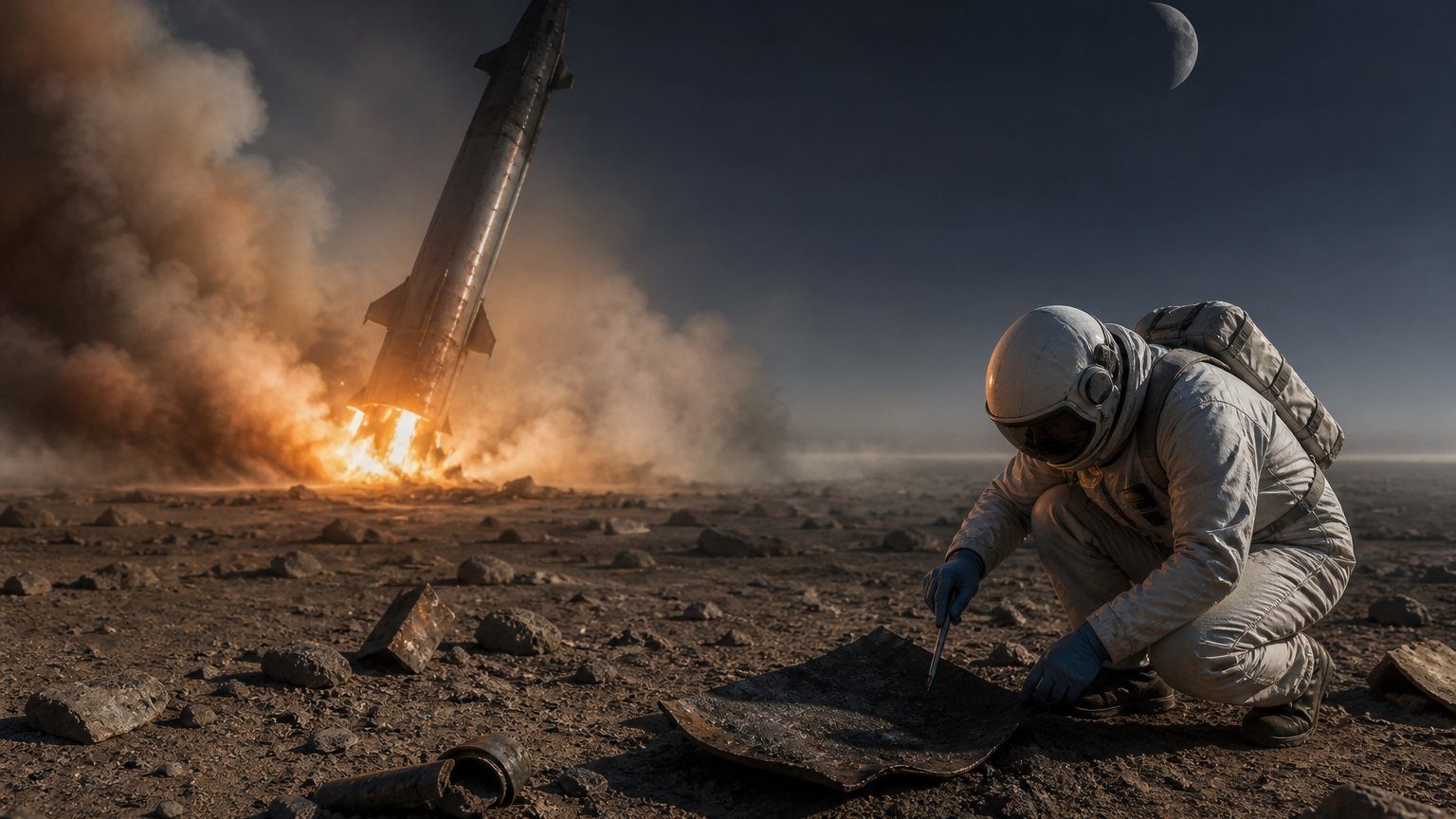
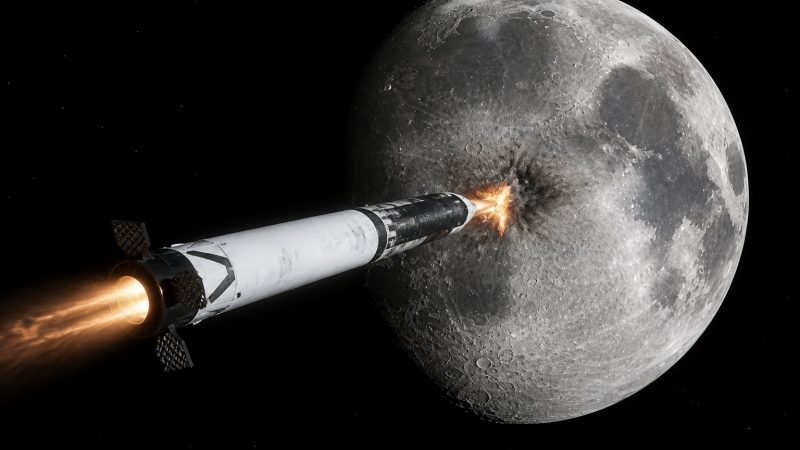
A SpaceX rocket crash on the Moon has created a new crater and a rare chance to study impacts that could guide future lunar missions.
A SpaceX rocket crash on the Moon has given planetary scientists an unexpected chance to study how impacts shape the lunar surface. The empty upper stage of a Falcon 9 struck near the Einstein crater on Wednesday, carving out a fresh crater and creating what researchers see as a rare scientific opportunity.
The impact happened at about 07:35 BST, or 06:35 GMT, at a speed of roughly 5,400 mph. The flash was so brief and faint that amateur observers would have had little chance of catching it, even with strong telescopes. Larger observatories in the Americas are now working through the data, and the first detailed results are expected to take time as images are cleaned up and analyzed.
Scientists say the event is especially useful because this was not a mystery strike. They already know the rocket stage’s size, its speed, and where it hit. That turns a stray collision into something close to a controlled test, letting researchers compare what they predict about crater formation, debris, and lunar shaking with what actually happened on the surface.
The spent upper stage had been left in a long, looping orbit after its January launch from Florida last year. That mission carried two lunar landers and used the rocket’s upper stage to send them beyond Earth’s orbit and onto a path toward the Moon. Over the next 18 months, the pull of the Earth, Moon, and Sun — along with pressure from sunlight — gradually nudged the stage onto a collision course.
“A SpaceX rocket crash on the Moon has created a new crater and a rare chance to study impacts that could guide future lunar missions.”
The object itself was not small. Roughly the size of a five-storey building and weighing at least 4,000kg, it drifted through space until those tiny forces pushed it into the Moon. Even then, the impact would have been hard to watch live. The flash happened in broad daylight for many regions, and any dust plume that followed could have stretched for as much as 100km across the lunar surface.
Spacecraft in lunar orbit were also poorly positioned to see the crash unfold. South Korea’s Danuri orbiter came closest, passing near the site shortly before impact, while NASA’s Lunar Reconnaissance Orbiter should be able to photograph the area in the coming days. Those before-and-after images may help confirm how much material was blasted out and how the surface changed.
For planetary geologists, the value of a SpaceX rocket crash lies in what it can reveal about future exploration. Understanding how much debris an impact throws into the air, how far that material travels, and how strongly the ground shakes can help engineers design safer landers and plan for future Moon bases. Fresh material kicked up from below the surface could also add clues about the Moon’s geology and its long connection to Earth.
This is not the first time a human-made object has hit the Moon. Since 1959, dozens of spacecraft have crashed there, some on purpose and some by accident. The first was the Soviet probe Luna 2, followed by NASA’s Ranger probes, several Apollo-era rocket stages, and the LCROSS mission in 2009, which was deliberately sent into the Moon in a search for water ice. A confirmed accidental impact in 2022 was linked to a booster thought to have been left over from a Chinese lunar mission launched years earlier. Why it matters: every such impact gives scientists better tools for protecting spacecraft, planning Moon landings, and building the next generation of lunar hardware.
Frequently asked questions
What hit the Moon?
The empty upper stage of a Spacex Falcon 9 rocket struck the lunar surface near Einstein crater.
Why are scientists interested in the crash?
Because they know the object’s size, speed, and impact point, they can compare real results with impact models.
Will anyone be able to see the crash site soon?
Nasa’s Lunar Reconnaissance Orbiter is expected to photograph the area in the coming days, and observatories in the Americas are processing data now.
Has anything like this happened before?
Yes. Dozens of human-made objects have hit the Moon since 1959, including both deliberate and accidental impacts.
We value your privacy 🍪We use cookies for essential features and, if you allow it, to send you a notification whenever we publish a new story. See our Privacy Policy.
📨
Never Miss a Story
Get the headlines that matter delivered straight to your inbox.
📱 On iPhone: tap the Share icon, choose “Add to Home Screen”, then open TheTrueDefender from your Home Screen and tap 🔔 to turn on notifications. (Apple only allows notifications for saved web apps.)
🔔
Never miss a breaking storyGet free alerts the moment big US news breaks.
1Tap the ••• menu at the bottom of the screen, then tap Share(in Safari, just tap Share in the bottom bar directly)2Scroll down the menu and tap Add to Home Screen3Tap Add in the top-right corner4Open TheTrueDefender from your Home Screen, then tap 🔔 Subscribe and choose Allow
📱 Add TheTrueDefender to your home screen for one-tap access.