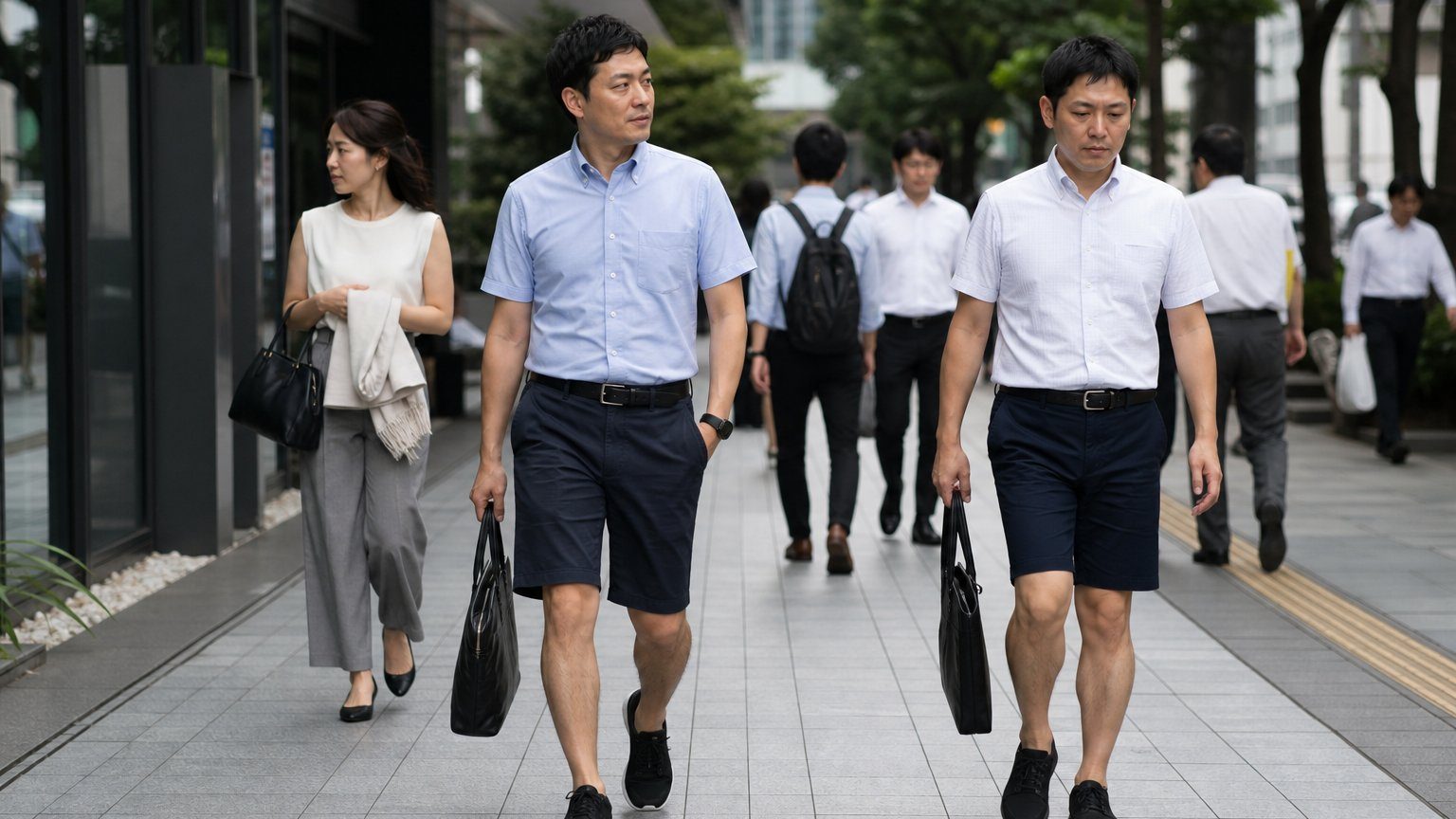
Tokyo Cool Biz is pushing lighter office wear, including shorts, but the Tokyo shorts at work move has drawn criticism from some women and workers.
Tokyo Cool Biz is back in the spotlight as the Tokyo Metropolitan Government urges office workers to trade suits and ties for lighter summer clothing, including t-shirts, trainers and even shorts. The Tokyo shorts at work push, backed by Governor Yuriko Koike, is meant to help people handle the season’s brutal heat more comfortably.
Koike introduced the city’s updated “Tokyo Cool Biz” effort in April as an expansion of her long-running summer dress initiative. The idea has been around in different forms for years, dating back to her time as Japan’s environment minister in 2005, when she launched a national energy-saving campaign encouraging workers to wear short-sleeve shirts. Former Prime Minister Junichiro Koizumi helped promote the effort by appearing publicly without a tie or jacket. After the 2011 Tohoku earthquake and tsunami, the government widened the guidance again under “Super Cool Biz” to cut energy use at work and at home.
Nearly four months into the latest push, reactions have been split. Some workers welcome the looser dress code because it makes summer days easier to manage. Others say the rule creates a new kind of double standard, since women are still expected to wear tights when parts of their legs are exposed. A few women have also used the online term “sunehara,” described as “leg hair harassment,” to express discomfort with seeing male coworkers’ leg hair.
“Tokyo Cool Biz is pushing lighter office wear, including shorts, but the Tokyo shorts at work move has drawn criticism from some women and workers.”
Tokyo Metropolitan Government environmental official Noboru Watanabe told the BBC the point is to give people more choices during intense heat, not to force a new uniform on anyone. He said there should be no problem as long as the clothing is not offensive to others. Still, a June survey by Gorilla Clinic found that 53.5% of respondents opposed wearing shorts to work in summer, while 46.5% supported the idea.
The clinic said the main reason people gave for opposing shorts was concern about body shape and body hair. It also said women made up a larger share of the responses, suggesting they may be more uneasy about seeing men’s bare legs at work. At the same time, some men have reportedly become more self-conscious about their own leg hair, and Gorilla Clinic director Akifumi Funatsu said more people are seeking laser hair removal as a matter of social etiquette when wearing shorts.
The debate comes as Japan faces record heat, higher energy prices tied to instability in the Middle East, and repeated warnings from forecasters about extreme temperatures. Officials have also been warning people about heatstroke, while residents buy products such as fan-equipped clothing, wet towels, UV-blocking umbrellas and portable fans. Why this matters: Japan’s office heat debate shows how extreme weather is reshaping daily life, workplace norms, and the practical choices workers make to get through summer.
Frequently asked questions
What is Tokyo’s Cool Biz campaign trying to change at work?
The Tokyo Metropolitan Government is encouraging office workers to wear lighter summer clothing such as t-shirts, trainers, and shorts instead of suits and ties. Officials say the goal is to help people handle intense heat more comfortably.
Who is backing the latest shorts-at-work push?
Tokyo Governor Yuriko Koike is backing the updated Tokyo Cool Biz effort. She introduced the expanded initiative in April.
Why are some people opposed to wearing shorts to work?
According to the article, concerns include body shape and body hair. Some women also say the practice creates a double standard because women are still expected to wear tights when their legs are exposed.
What did the Gorilla Clinic survey find about public opinion?
The June survey found 53.5% of respondents opposed wearing shorts to work in summer, while 46.5% supported it. The clinic said women made up a larger share of responses.
We value your privacy 🍪We use cookies for essential features and, if you allow it, to send you a notification whenever we publish a new story. See our Privacy Policy.
📨
Never Miss a Story
Get the headlines that matter delivered straight to your inbox.
📱 On iPhone: tap the Share icon, choose “Add to Home Screen”, then open TheTrueDefender from your Home Screen and tap 🔔 to turn on notifications. (Apple only allows notifications for saved web apps.)
📱 Add TheTrueDefender to your home screen for one-tap access.