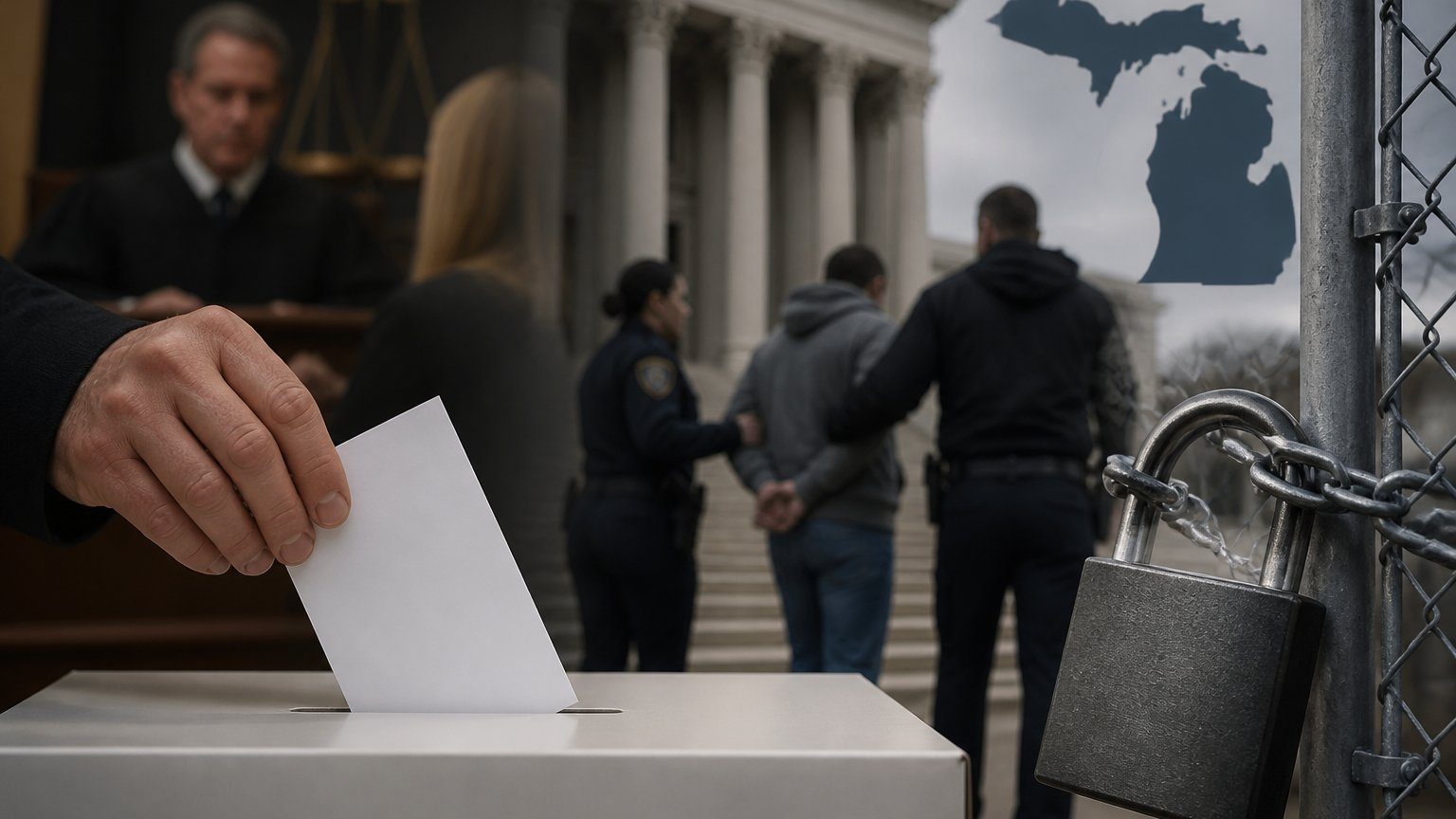
Michigan illegal voting charges against six people, including five noncitizens, have renewed the fight over voter ID, citizenship checks, and election security.
Michigan illegal voting charges are pushing election security back into the national spotlight after state officials announced cases involving five noncitizens and one U.S. citizen accused of election-related crimes. House Speaker Mike Johnson seized on the development Thursday, saying the case shows why Americans should worry about whether only eligible voters are reaching the ballot box.
Johnson took to X and argued that the evidence of noncitizens registering and voting is building from New Jersey to Michigan. He said Democrats want open borders and oppose voter ID, and he called the issue a “clear and present danger” to election integrity and to the Republic. Johnson added that Republicans are the ones working to make elections secure. His comments came after Michigan Attorney General Dana Nessel announced the charges.
Nessel said five non-U.S. citizens were charged with illegally voting in the 2024 presidential election, along with a U.S. citizen accused of registering her noncitizen husband. Her office said the case grew out of a review of 38 suspected instances of noncitizen voting or related conduct dating from 2009 through 2025. Of those, six resulted in criminal charges, 10 were closed without charges, and 22 are still under review.
Nessel said her office treats election crimes seriously and prosecutes attacks on voting systems to the fullest extent of the law. She said investigators are working to uphold election integrity by reviewing all claims of noncitizen voting, which she described as rare, and by holding accountable anyone who refuses to follow the laws that protect elections. State officials have said illegal voting by noncitizens remains extremely rare, even as Michigan counted more than 5.7 million ballots in the November 2024 general election.
The Michigan illegal voting charges include a range of allegations. Robert Piva, 67, of Roseville, a permanent resident, is accused of election law perjury, attempting to vote while unqualified, and fraudulent registration. He allegedly voted early in October 2024 and said his vote was an experiment involving voter fraud. Michael Akioya, 39, of Oak Park, also a permanent resident, faces misdemeanor counts tied to alleged false statements on an absentee voter application and ballot envelope.
“Michigan illegal voting charges against six people, including five noncitizens, have renewed the fight over voter ID, citizenship checks, and election security.”
Alondra Harker, 26, of Three Rivers, a limited-term alien resident, was charged with fraudulent registration after allegedly registering and voting in person in 2024. Harumi Michael, 60, of Wolverine Lake, a permanent resident, faces three felony counts and one misdemeanor after allegedly registering and voting in Commerce Township. Basanth Sadasivian, 29, a non-citizen living in the United Kingdom, is charged with attempting to vote while unqualified after allegedly registering and voting through the Federal Post Card Application system using a Bloomfield Hills address. Kimberley DiDonato, 60, of Rose Township, is accused of posing as her noncitizen husband to register him online and faces forgery and computer crime charges. Authorities said she claimed she wanted to test weaknesses in the system before asking to cancel the registration.
Nessel’s office also said it declined to charge four other referred people after finding that two were U.S. citizens, one was a citizen through an international adoption, and another was a federally recognized American Indian born in Canada. Six more cases were closed without charges because investigators found no evidence of criminal intent or possible registration errors. Nessel said delays in federal cooperation slowed the inquiry, adding that federal agencies did not always provide easy access to citizenship records.
The dispute lands in the middle of a broader national argument over who can vote, how citizenship is verified, and how much authority states should have over their own election systems. President Donald Trump’s administration has made illegal voting prevention a priority, signing executive orders in March 2025 and March 2026 aimed at strengthening citizenship verification for federal elections and giving states better access to citizenship and immigration data. The administration has also backed legislation that would require proof of U.S. citizenship to register for federal elections.
For American voters, the Michigan illegal voting charges matter because confidence in elections depends on trust that only eligible citizens are casting ballots. The next developments will likely come from the court cases in Michigan and from the continuing national fight over voter ID, citizenship checks, and federal access to state election data.
Frequently asked questions
Who was charged in Michigan?
Michigan Attorney General Dana Nessel announced charges against five noncitizens and one U.S. citizen in election-related cases.
What did the state review find?
Officials reviewed 38 suspected cases of noncitizen voting or related conduct from 2009 to 2025. Six cases led to charges, 10 were closed, and 22 remain under review.
How did Speaker Mike Johnson respond?
Johnson said the cases show a growing threat to election integrity and argued that Republicans are fighting for secure elections.
What happens next?
The charged defendants will face their cases in Michigan, while the broader debate over voter ID and citizenship verification is likely to continue nationally.
We value your privacy 🍪We use cookies for essential features and, if you allow it, to send you a notification whenever we publish a new story. See our Privacy Policy.
🇺🇸
The Defender Morning Brief
5 stories Americans need to know. 3 minutes. Every morning. Free.
📱 On iPhone: tap the Share icon, choose “Add to Home Screen”, then open TheTrueDefender from your Home Screen and tap 🔔 to turn on notifications. (Apple only allows notifications for saved web apps.)
🔔
Stay Ahead of Breaking NewsGet alerts when major stories break — not every time we publish.Breaking news only. No spam. Turn off anytime.
1Tap the ••• menu at the bottom of the screen, then tap Share(in Safari, just tap Share in the bottom bar directly)2Scroll down the menu and tap Add to Home Screen3Tap Add in the top-right corner4Open TheTrueDefender from your Home Screen, then tap 🔔 Subscribe and choose Allow
📱 Add TheTrueDefender to your home screen for one-tap access.